
































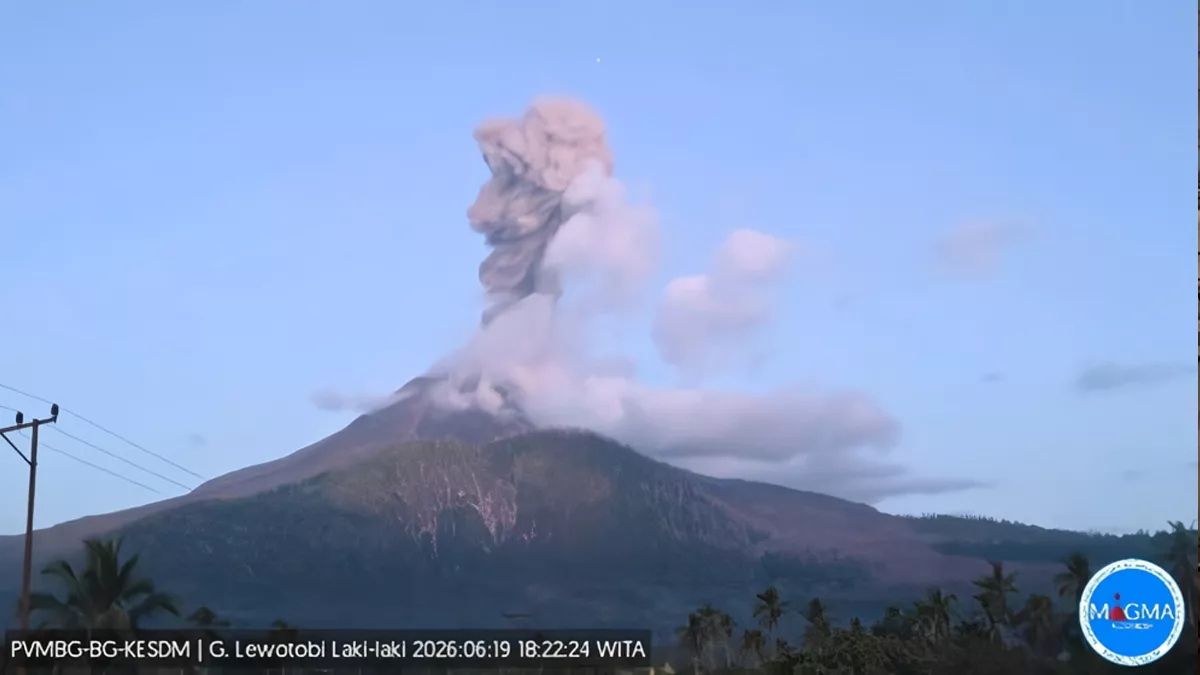
FLORES, Indonesia — Mount Lewotobi Laki-Laki, one of Indonesia’s most active volcanoes, erupted again on Saturday morning, sending an ash plume approximately 1,000 metres (3,280 feet) above its summit as authorities renewed warnings for residents and travelers to stay away from the danger zone.
The eruption occurred at 8:12 a.m. local time on Flores Island in East Nusa Tenggara Province, according to Indonesia’s Center for Volcanology and Geological Hazard Mitigation (PVMBG).
Officials said the eruption lasted for approximately one minute and 34 seconds, with volcanic activity recorded on monitoring instruments at a maximum seismic amplitude of 44.4 millimetres.
The volcano remains at Alert Level III (Siaga), Indonesia’s second-highest warning level.
Authorities have advised the public, including tourists, not to enter a five-kilometre (3.1-mile) radius around the crater.
Volcanologist Bramantya Aji Putra Mahendra, who heads the Lewotobi Volcano Observation Post, said recent lava deposits extend roughly 4.3 kilometres to the northeast and 3.8 kilometres to the west, underscoring the need to keep the exclusion zone in place.
Officials also warned communities living along river systems originating from the volcano to remain alert for volcanic mudflows (lahars) if heavy rainfall occurs.
Lahars can develop rapidly when rain mixes with volcanic ash and loose debris, posing serious risks even after an eruption has ended.
Residents in areas including Dulipali, Padang Pasir, Nobo, Nurabelen, Klatanlo, Hokeng Jaya, Boru, and Nawakote have been advised to monitor local conditions closely during periods of heavy rain.
Authorities are also encouraging anyone exposed to falling ash to wear face masks or other protective coverings to reduce the risk of respiratory problems.
What Travelers Should Know
Mount Lewotobi is located on Flores Island, several hundred kilometres east of Bali. While the eruption does not currently affect daily life in Bali, travelers planning to visit Flores or nearby destinations should monitor official advisories and check with airlines and tour operators before departure.
As of Saturday morning, no official announcement of flight disruptions related to this eruption had been issued.
Indonesia sits on the Pacific “Ring of Fire,” home to more active volcanoes than any other country. Eruptions are closely monitored by authorities, and exclusion zones are adjusted according to volcanic activity.
For visitors exploring eastern Indonesia, officials recommend respecting all restricted areas and following instructions issued by local authorities and park officials.