


































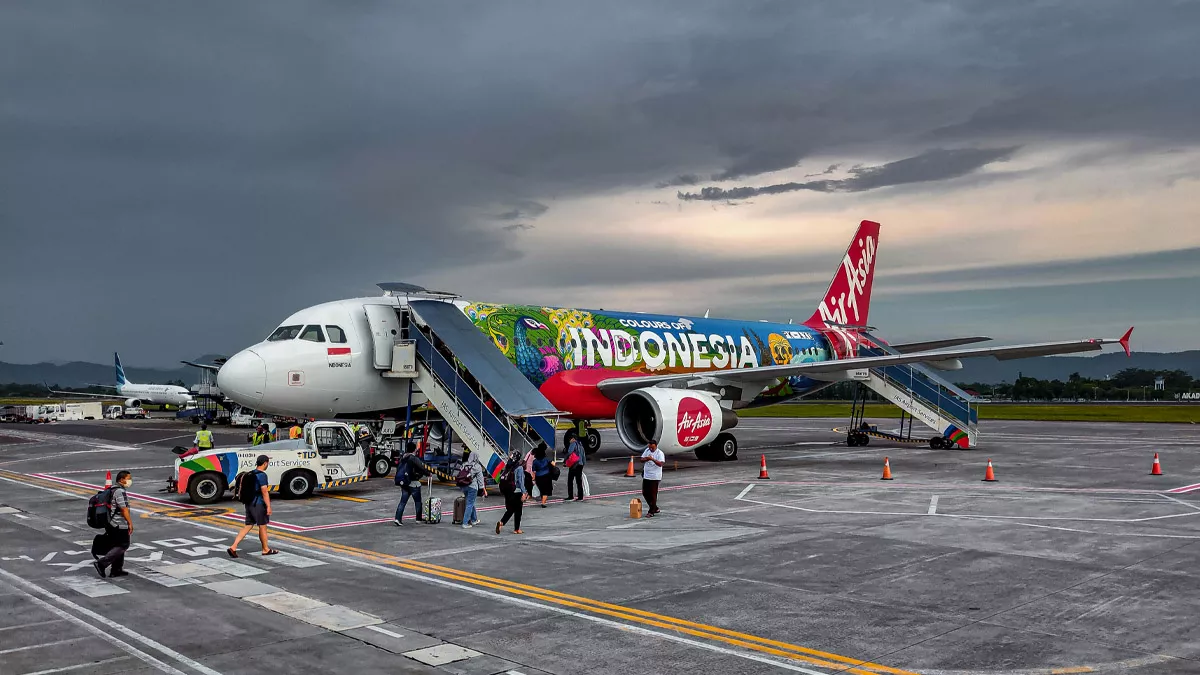
LABUAN BAJO, Indonesia — For passengers aboard AirAsia flight QZ860 from Jakarta on Saturday afternoon, the gateway to Komodo National Park—one of Indonesia’s most celebrated natural wonders—was momentarily locked by the raw forces of nature. As the aircraft approached Komodo International Airport in Labuan Bajo, it was met not with a landing strip, but with a wall of torrential rain and buffeting winds, forcing it into a prolonged, 90-minute holding pattern above the storm-lashed coast.
The incident, confirmed by airport authorities and reported by local media, serves as a visceral reminder of the powerful seasonal weather that can dictate travel schedules across the Indonesian archipelago, even to its most premier destinations.
According to Marwa, the public relations officer for Komodo International Airport, the severe weather system moved in around 4:30 PM local time. “Due to the bad weather in Labuan Bajo, the aircraft was circling or waiting in the air,” Marwa stated, as quoted by Detik.com. The flight, which had been scheduled to land in the late afternoon, was finally able to touch down safely at approximately 6:00 PM, after the intense cell had partially passed.
Navigating the “Musim Hujan”
The episode underscores a critical, yet often underestimated, aspect of travel in tropical Southeast Asia: the profound impact of the rainy season, or musim hujan. While Bali and parts of eastern Indonesia like Labuan Bajo are perennially popular, the months spanning approximately November to March can bring unpredictable and intensely localized storms.
For pilots, the decision to enter a holding pattern is a standard—and safety-first—protocol. Landing in conditions of poor visibility, heavy precipitation, and strong crosswinds poses significant risks. Circling allows a flight to wait for a clearance window, burn excess fuel to achieve a safer landing weight, or, if conditions fail to improve, divert to an alternate airport.
A Broader Context for Regional Travelers
For the global community in Bali—a hub for travelers exploring the wider region—this incident is a relevant case study in travel contingency planning. Labuan Bajo, the jump-off point for Komodo dragon tours and spectacular diving, is a common side-trip. Such weather-related delays, while unsettling, are an operational reality.
They highlight the importance of building buffer days into intricate travel itineraries, especially when connecting to remote destinations or booking immediate onward journeys. Travel insurance that covers delays and missed connections also becomes not just a luxury, but a practical necessity during the wet season.
Safety as the Uncompromising Priority
Airport officials emphasized that the procedure, while undoubtedly trying for passengers, concluded without incident. “It has landed and continued on to its next flight,” Marwa confirmed, indicating the aircraft later departed back to Jakarta.
The successful resolution aligns with global aviation safety standards, where patience in the air is always favored over haste on the ground. For visitors drawn to the rugged beauty of places like Labuan Bajo and Komodo, this incident is a testament to the infrastructure and protocols that operate to ensure their adventures begin and end safely, even when the famed Indonesian hospitality is momentarily challenged by the weather’s might.
The skies have since cleared over Labuan Bajo, but the story of flight QZ860’s patient circles in the storm offers a clear lesson: in the archipelago, respecting nature’s timetable is an integral part of the journey.