
































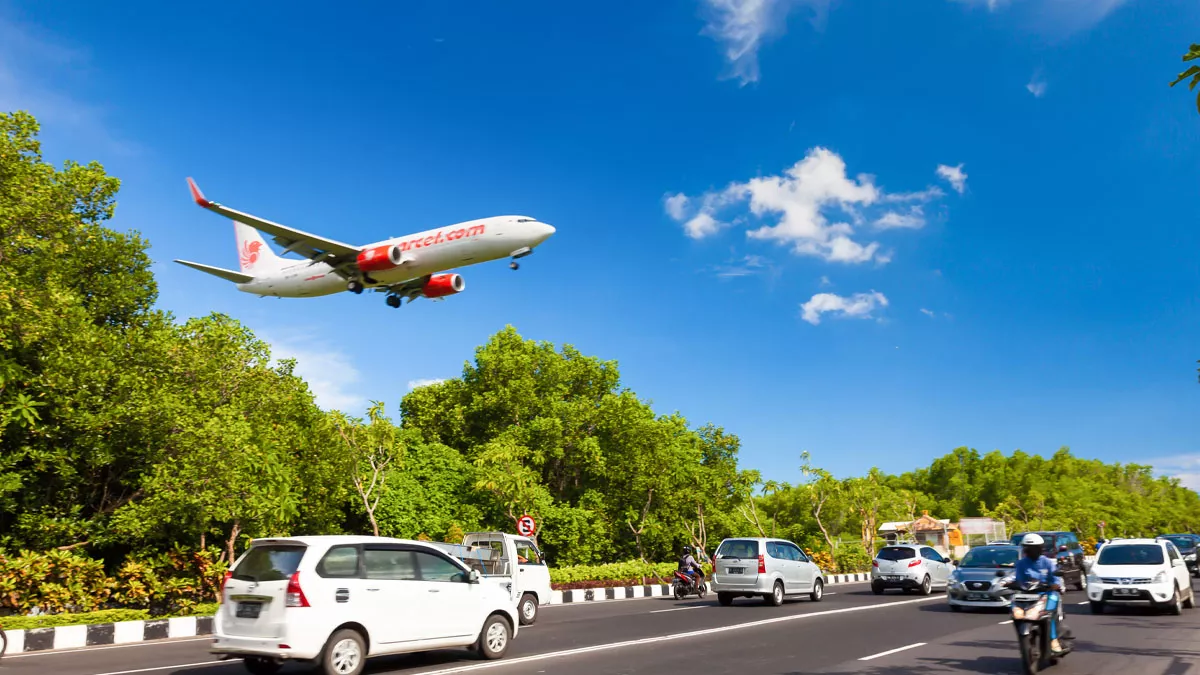
A one-way business class ticket from Bali to Jakarta now costs more than Rp 14 million.
That is approximately USD 870. For a domestic flight. Between two Indonesian cities.
For context, that same amount could buy a return ticket from Bali to Singapore, Kuala Lumpur, or Bangkok — with money left over for a week of meals.
The price spike is not a glitch. It is the result of a government policy allowing airlines to raise fuel surcharges by up to 50 percent following a sharp increase in avtur (aviation fuel) prices, driven by rising global geopolitical tensions.
As of May 1, 2026, the average price of avtur reached Rp 29,116 per liter. Airlines received permission to apply the new surcharge starting May 13.
And the impact on travelers — particularly those flying between Bali and Jakarta, Indonesia’s two busiest tourism and business hubs — has been immediate.
The Numbers That Shocked Even Politicians

Gede Pasek Suardika, a Balinese politician and advocate, took to social media to express what many travelers are feeling: frustration.
“Now plane tickets are completely out of control,” he wrote on his Facebook page.
He laid out the numbers. Economy class fares from Bali to Jakarta, which previously ranged from Rp 1.8 million to Rp 2.2 million, have climbed. Business class tickets now range from Rp 4 million to Rp 14.4 million for a single flight.
According to data collected by Tribun Bali from a major online travel agency on May 20, 2026, the cheapest economy ticket for the Bali-Jakarta route was Rp 1.6 million — for a late-night flight on Lion Air.
At the same time, business class fares on Batik Air and Garuda Indonesia for the same route and date started at Rp 4 million and climbed past Rp 14 million.
Pasek warned that domestic tourism to Bali is now at risk. “People are reluctant to go on holiday at such high costs,” he said.
A Dilemma With No Easy Answer
The government’s decision to raise the fuel surcharge cap did not come without warning.
Tulus Abadi, Chairman of the Indonesian Consumer Empowerment Forum (FKBI), described the policy as deeply dilemmatic.
“If the increase is not implemented, the survival of airlines could be threatened,” he said in a written statement on May 17, 2026. “It could even threaten flight safety.”
But the consequence of the increase is equally concerning: higher prices will suppress demand. And suppressed demand means fewer tourists flying to Bali.
For an island where tourism accounts for nearly 60 percent of the economy, that is not an abstract statistic. It is a direct threat to livelihoods, hotel occupancy rates, and the recovery momentum built since the pandemic.
What the Government Says
Lukman F. Laisa, Director General of Civil Aviation, defended the policy as a necessary mechanism to anticipate fuel price fluctuations while maintaining the sustainability of air transportation services.
“The fuel surcharge adjustment is based on mechanisms and formulations set out in regulations,” Lukman said in a written statement on May 14, 2026. “The government ensures that the implementation of this policy is carried out in a measured manner, while still paying attention to consumer protection, fare affordability, and the sustainability of airline operations.”
He added that airlines remain required to maintain service quality and must list the fuel surcharge separately from the basic fare on passenger tickets.
The Directorate General of Civil Aviation says it will continue to monitor and evaluate the policy to ensure transparency, accountability, and fairness to the public.
The Risk: Domestic Tourists Will Stay Home
For expats and global travelers, the price spike may be frustrating but manageable. Those earning in dollars, euros, or Australian dollars will absorb the increase more easily.
But for domestic tourists — the millions of Indonesians who travel from Jakarta, Surabaya, and other major cities to Bali for holidays, family visits, and weddings — the price increase is a serious barrier.
If a family of four must spend Rp 6 million to Rp 8 million just on plane tickets, many will simply cancel their trips. They will vacation closer to home. Or they will not vacation at all.
That shift would hit Bali’s economy hard. Domestic tourists account for a significant portion of the island’s visitors, particularly during weekends, national holidays, and school breaks.
Proposed Solutions

Tulus Abadi offered several mitigation measures to prevent the damage from spreading further.
First, he called for stronger supervision to ensure airlines do not exceed the 50 percent maximum surcharge.
Second, he urged the government to monitor airline performance, particularly on-time performance (OTP). When passengers pay premium prices, they expect premium reliability.
Third, he proposed that the government consider eliminating or reducing the VAT on airline tickets, which he described as a significant component of the final price.
Fourth, he suggested special subsidies for airlines serving the 3T regions (frontier, outermost, and disadvantaged areas), where air travel is often the only mobility option.
For the Bali-Jakarta route, however, the damage may already be done.
A business class ticket from Bali to Jakarta should not cost more than a flight to Europe.
But under current policy, it does.
The government faces a difficult trade-off: protect struggling airlines from fuel costs, or protect struggling tourism from fare hikes. Right now, the scale tilts toward airlines.
For travelers — domestic and international alike — the message is clear: book early, compare fares across airlines, and prepare to pay significantly more than you did last year.
And for Bali’s tourism industry, the warning is equally clear: when plane tickets become unaffordable for domestic visitors, the island’s recovery will face a headwind that no marketing campaign can overcome.