
























DENPASAR, Bali — Parts of Bali may face a noticeably drier dry season this year, as Indonesia’s meteorological agency warns that a developing El Nino pattern could reduce rainfall across key regions of the island.
The Meteorology, Climatology and Geophysics Agency (BMKG) says the 2026 El Nino, although expected to remain relatively weak, is likely to influence weather conditions between May and October—particularly in areas already prone to low rainfall.
According to Aminudin Al Roniri, head of Bali’s climatology station, the impact will not be evenly distributed.
Northern Bali, especially the coastal areas of Buleleng Regency, is expected to be among the most affected.
“Historically, northern Bali is the most vulnerable to drought during the dry season,” Aminudin said on April 7, citing long-term climatological data.
Districts such as Gerokgak, Kubutambahan, and Tejakula—stretching along Buleleng’s coastline—are identified as areas where reduced rainfall could become more pronounced.
Nusa Penida and South Bali Also at Risk
The impact is not limited to the north.
BMKG also points to Nusa Penida, the island district southeast of Bali, as another area likely to experience drier-than-usual conditions. Known for its rugged terrain and limited freshwater resources, Nusa Penida is particularly sensitive to shifts in rainfall patterns.
Parts of southern Badung, including South Kuta—home to some of Bali’s most visited coastal destinations—may also see reduced precipitation during the dry season.
“These regions are naturally drier compared to other parts of Bali. With rainfall predicted to be below normal this year, the effect becomes more significant,” Aminudin explained.
A Subtle but Important Shift
While the projected El Nino is categorized as weak, its influence should not be underestimated.
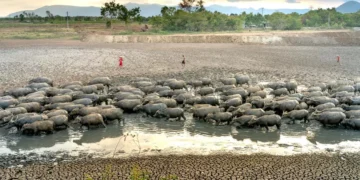
El Nino events typically suppress rainfall across Indonesia, altering seasonal patterns that local agriculture, water systems, and daily life depend on.
In Bali, where water management already varies significantly between regions, even a moderate reduction in rainfall can have visible effects—especially in areas without robust water infrastructure.
No Official Drought Warning—For Now
Despite the outlook, BMKG has not issued an official drought warning.
The island is currently in a seasonal transition period, and authorities say it is too early to declare a meteorological drought.
“We are still in the transition phase. A formal early warning will be issued once the indicators are met,” Aminudin said.
What This Means for Travelers and Residents
For visitors and expatriates in Bali, the forecast does not signal disruption—but it does offer context.
A drier season can mean:
- reduced rainfall during peak travel months
- drier landscapes, particularly in the north and outer islands
- increased pressure on local water resources
In destinations like Nusa Penida, where infrastructure is more limited, water availability can become more noticeable during prolonged dry periods.
A Familiar Pattern, With Local Consequences
El Nino is not new to Indonesia. But each cycle interacts differently with local conditions.
In Bali, geography matters. Northern and island regions tend to receive less rainfall even in normal years. When broader climate patterns shift, these areas feel it first—and more intensely.
This year may follow that pattern.
Not dramatically. Not suddenly.
But enough to remind residents and visitors alike that Bali’s climate, often perceived as predictable, is part of a larger and increasingly variable system.
The forecast is not a warning of crisis.
But it is an early signal.
A weaker-than-usual El Nino can still reshape a season—quietly, gradually, and unevenly.
And in places like Buleleng and Nusa Penida, where water is already a balancing act, even small shifts in rainfall can carry larger consequences.