


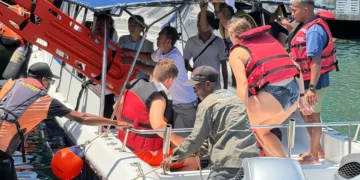




























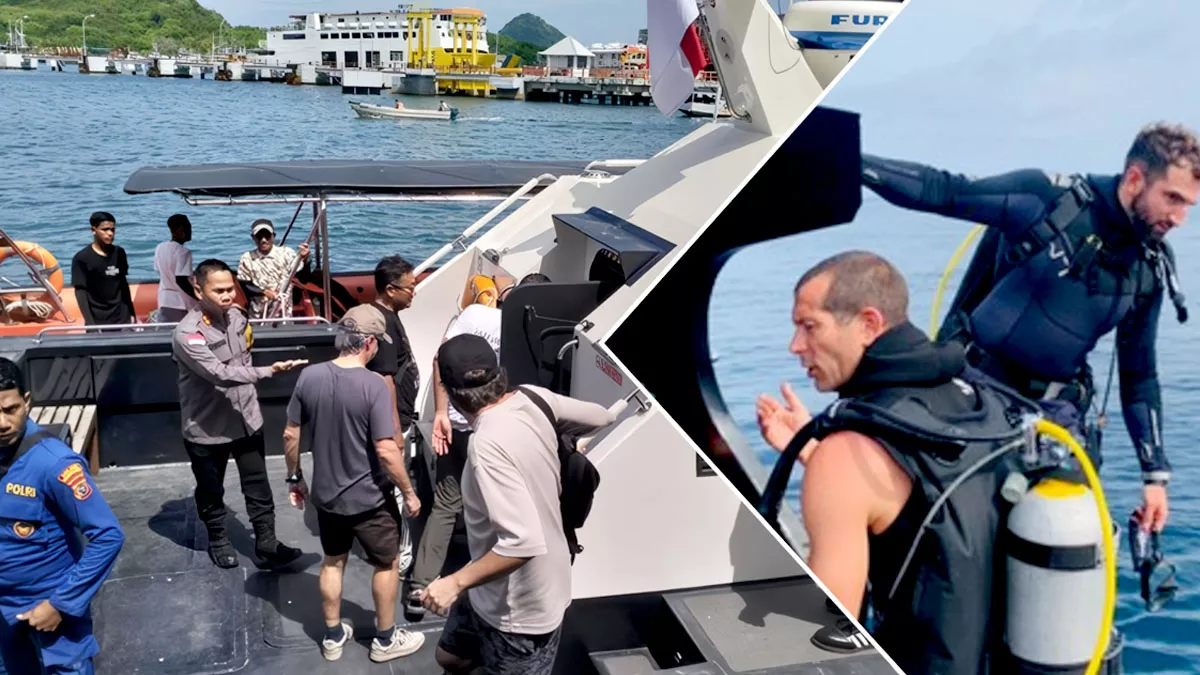
HEYBALI.NEWS – The search for survivors and victims of the sinking of the tourist vessel Putri Sakinah entered its seventh day on Thursday, with members of the victims’ family joining Indonesian rescue teams at sea in a renewed effort to locate three people still missing in the waters off Komodo National Park.
The vessel went down last week in the Padar Strait, a narrow and often unpredictable channel between islands in eastern Indonesia. Despite days of intensive operations involving divers, sonar equipment, and patrol boats, three passengers remain unaccounted for: Fernando Martin Carreras, a coach for Valencia CF’s women’s B team, and his two young sons.
On Thursday morning, family representatives traveled to the search area alongside members of the joint search and rescue team, according to Budi Widjaja, head of the Labuan Bajo branch of the Indonesian Association of Marine Tourism Entrepreneurs (Gahawisri), who has been accompanying the family during the operation.
“The family will go directly to the incident site and to locations where sonar equipment has been deployed,” Mr. Widjaja said.
Family Presence at Sea
Those joining the search include the victim’s brother-in-law and uncle by marriage, as well as Fernando, the Deputy Ambassador of Spain to Indonesia. The presence of diplomatic officials underscores both the international dimension of the tragedy and the continuing concern from Spanish authorities.
Mr. Carreras’s wife did not take part in Thursday’s sea search. She was accompanying the body of the couple’s daughter, who was found earlier this week, as it was transferred from Komodo Regional Hospital in Labuan Bajo to Bali.
Using a vessel provided by Indonesian police, the family plans to visit several points in the Padar Strait where rescue teams have been concentrating their efforts, including areas identified through underwater scanning.
Moving Phone Signal Raises Questions
Complicating the search is a technical detail that has drawn significant attention: the detection of a mobile phone signal believed to belong to Mr. Carreras.
According to Mr. Widjaja, coordinates linked to the phone were identified with assistance from the International Criminal Police Organization (Interpol). However, the signal has not remained fixed.
“The coordinates have shifted,” he said. “At one point the signal was detected south of the Padar Strait, and later it appeared north of Batu Tiga Island.”
Rescue coordinators believe the phone may be inside the submerged vessel or among debris that continues to drift with strong currents in the area, known for complex tidal flows and underwater contours.
“There is a possibility the phone is still within the wreckage and is being carried by the current,” Mr. Widjaja explained.
A Search Under Pressure
The Padar Strait, while scenic by day, presents formidable challenges to maritime operations. Strong currents, limited visibility below the surface, and rapidly changing conditions have hampered rescue divers throughout the week.
Indonesian regulations typically limit formal search and rescue operations to seven days, though extensions are possible if credible new evidence emerges. Officials have not yet announced whether the operation will be prolonged.
For the family now searching alongside professionals, the seventh day marks a painful threshold, blending hope with an increasing awareness of the sea’s unforgiving realities.
In Labuan Bajo, a gateway to one of Indonesia’s most celebrated national parks, the tragedy has cast a quiet shadow over the tourism town, reminding residents and visitors alike that beneath postcard landscapes lie waters that demand respect, caution, and humility.














Comments 1