
























Labuan Bajo, Indonesia — The search for a missing Valencia youth coach and his two children in the waters of Komodo National Park has entered a critical phase, as investigators reveal that the victim’s mobile phone emitted brief signals on two separate occasions days after the vessel was reported lost.
According to Budi Widjaja, a family liaison assisting the coach’s wife, the phone signal was first detected in the early hours of December 27, at approximately 1:00 a.m. Central Indonesia Time. A second signal appeared the following day, on the afternoon of December 28.
“These detections were confirmed through coordination with Komdigi,” Widjaja told reporters on Thursday evening, referring to Indonesia’s Ministry of Communication and Digital Affairs. Because the registered phone number is an international number from Spain, the ministry escalated the request through overseas channels, including coordination with Interpol.
The first signal, Widjaja said, was traced to waters south of Padar Island, toward the direction of Rinca Island. The second signal, detected a day later, originated north of Padar Island, near an area known locally as Batu Tiga.
Despite these digital traces, search teams have so far found no physical evidence.
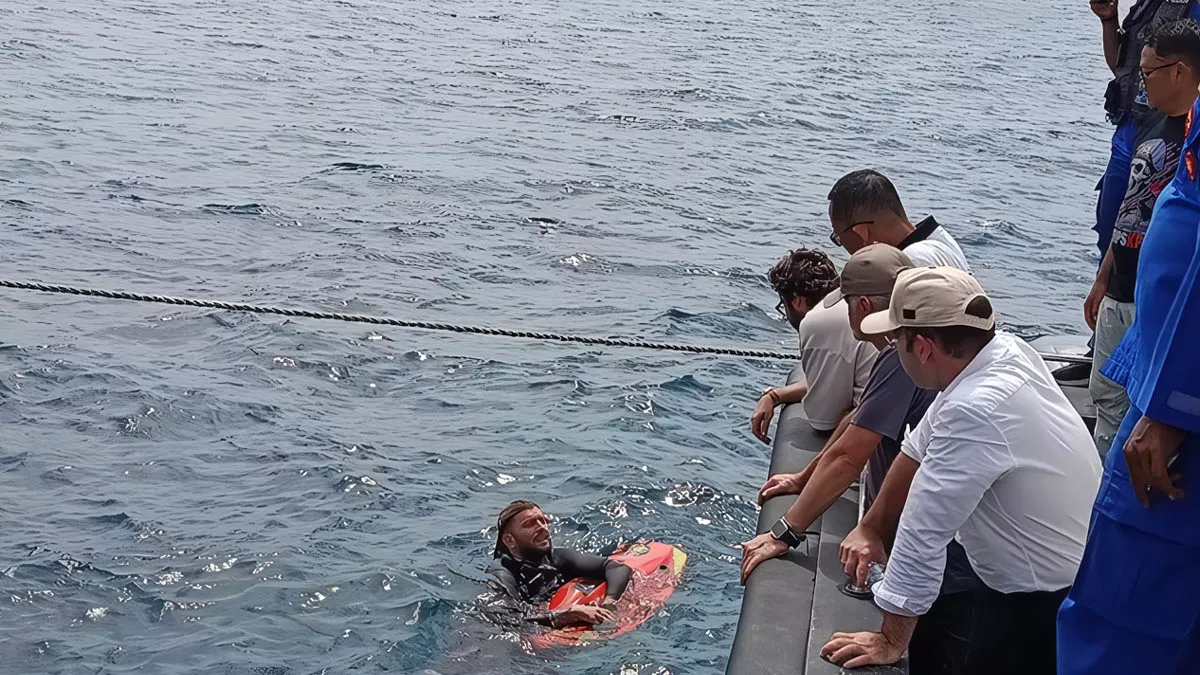
Fathur Rahman, head of the Maumere Search and Rescue Office, confirmed that crews were deployed to both coordinate points identified through the signal analysis. “We conducted searches at the reported locations, but the results were nil,” he said.
By Thursday afternoon, the operation had reached its seventh day without locating the missing coach or his two children. Following an evaluation involving multiple agencies, Indonesian authorities agreed to extend the search for an additional three days, responding to requests from the Spanish embassy, the local port authority (KSOP), and based on the arrival of specialized equipment.
The next phase of the operation will shift its focus below the surface.
“Over the coming days, we will prioritize sonar technology to map the seabed and analyze underwater conditions,” Fathur explained. The effort will be supported by experts from the Bandung Institute of Technology (ITB), particularly in interpreting current patterns that may indicate possible drift paths.
Should the sonar identify anomalies or objects of interest, dive teams will be redeployed for targeted underwater searches.
The waters surrounding Padar Island, part of the UNESCO-listed Komodo National Park, are known for strong and unpredictable currents, a factor that has complicated the operation since the beginning. For now, authorities continue to balance hope with realism, guided by the last faint digital signals left behind in the vast expanse of sea.
#HeyBaliNews