






























BALI — A 16-day power blackout in Aceh has sent a quiet but powerful signal across Indonesia’s tourism and property sectors, particularly in Bali. For luxury villa investors, the crisis is not distant news from another province. It is a stark reminder of how fragile centralized power systems can be and how quickly comfort, safety, and business continuity can vanish.
In Bali, where reliability is inseparable from reputation, the Aceh blackout has accelerated a fundamental shift already underway. Solar power is no longer viewed as a symbolic green feature for marketing brochures; it is increasingly treated as critical investment insurance.
When the National Grid Is No Longer Enough

Criticism of Indonesia’s state utility during the Aceh crisis highlighted a familiar vulnerability. Even with ongoing repairs, there was no certainty over when full power would be restored. For businesses dependent on uninterrupted electricity, such uncertainty translates directly into economic loss.
Teuku Yudhistira, chairman of the Indonesian Online Journalists Association and national coordinator of the Electricity Volunteers for the Nation, argues that the prolonged outage reflected a failure to deploy readily available solutions.
“One of the most practical and fastest ways to restore power during an emergency is through solar panels equipped with battery storage, while waiting for the main grid to be repaired,” Yudhistira said.
For owners of luxury villas in Seminyak, Uluwatu, or Canggu, the implication is clear. Waiting for the grid to recover is no longer a viable strategy when energy independence is an achievable reality.
Turning Energy Risk Into the Ultimate Selling Point
Energy vulnerability is now actively shaping how high-end properties in Bali are designed, marketed, and valued. This drive for self-sufficiency aligns with the core Balinese philosophy of Tri Hita Karana—the pursuit of harmony between the spiritual, human, and natural realms. For a luxury villa, achieving palemahan (harmony with the environment) now means more than organic gardens; it means securing a stable, respectful relationship with natural resources to ensure parahyangan (spiritual peace) for its inhabitants.
“In the luxury market, perception is reality,” notes Giostanovlatto, founder of Hey Bali and an observer of the island’s tourism dynamics. “What Aceh demonstrated is that ‘luxury’ can no longer be defined solely by thread count or private pools. The highest premium is now on predictability itself. For discerning travelers and long-term residents, a property’s ability to guarantee continuity—come what may with the national grid—has become the defining feature of a true sanctuary.”
This cultural and practical shift manifests in three key value propositions:
1. Uninterrupted Comfort as the New Luxury Baseline
As Yudhistira notes, “Solar power systems with batteries can operate independently, without relying on damaged grids or fuel supplies.” For ultra-luxury guests, the assurance that air conditioning, lighting, and connectivity will remain stable during regional outages has moved from a premium perk to a fundamental expectation.
2. Operational Independence from Institutional Failure
In Aceh, fuel distribution for generators was hampered by damaged access routes. Solar-powered villas eliminate reliance on these fragile external supply chains at the precise moment they tend to collapse, offering true operational sovereignty.
3. A Magnet for the Future-Proof Traveler
Properties marketed as fully energy-independent are increasingly perceived as safer, more resilient choices. They attract a growing demographic of high-net-worth digital nomads and long-stay travelers for whom “future-proofing” is a primary concern in an era of climate uncertainty.
A Strategic Shift in Development Philosophy
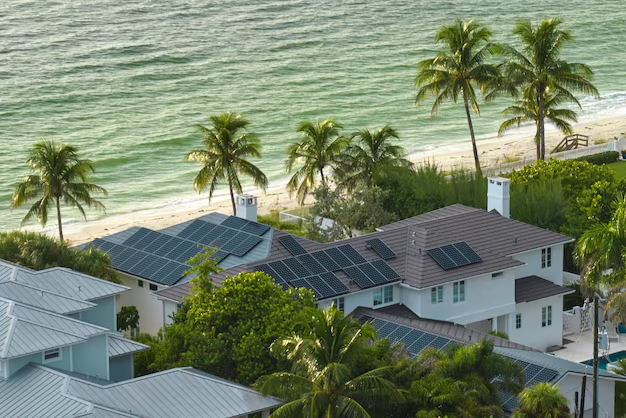
Developers and investors planning new projects are drawing clear, practical lessons from Aceh. The calculus has changed: relying solely on the national grid is now seen as an untenable risk. New blueprints mandate that solar panels must be paired with sufficient battery storage to ensure 24/7 resilience, not just daytime savings.
Perhaps most crucially, how this resilience is communicated has evolved. Properties that transparently position themselves as off-grid or hybrid-powered are no longer niche products for eco-purists. They are a direct, compelling response to a mainstream demand for guaranteed reliability.
From Energy Rhetoric to Tangible Readiness
Yudhistira has warned of a persistent gap between Indonesia’s energy transition narrative and its on-the-ground preparedness. Renewable projects are often celebrated at launch but remain absent when emergencies strike.
For Bali, this gap carries direct economic consequences. The island’s tourism-driven brand depends on an unshakeable perception of stability and trust. Villas and developments that fail to bridge this gap—that offer only rhetoric, not readiness—risk rapid obsolescence.
The lesson from Aceh is not ideological. It is operational. When the lights go out, only those prepared to operate independently remain unaffected, profitable, and credible.
In Bali’s hyper-competitive property market, energy resilience is fast becoming the non-negotiable standard of luxury. The critical question for investors and developers is no longer if to adapt, but how swiftly they can future-proof their assets—and their promises—against an uncertain future.
Hey Bali News provides authoritative analysis on the trends shaping investment, luxury, and sustainable living in Bali for a global audience.














Comments 1