

































By Giostanovlatto, Founder Hey Bali.
DENPASAR, Bali — The most telling detail was the soup.
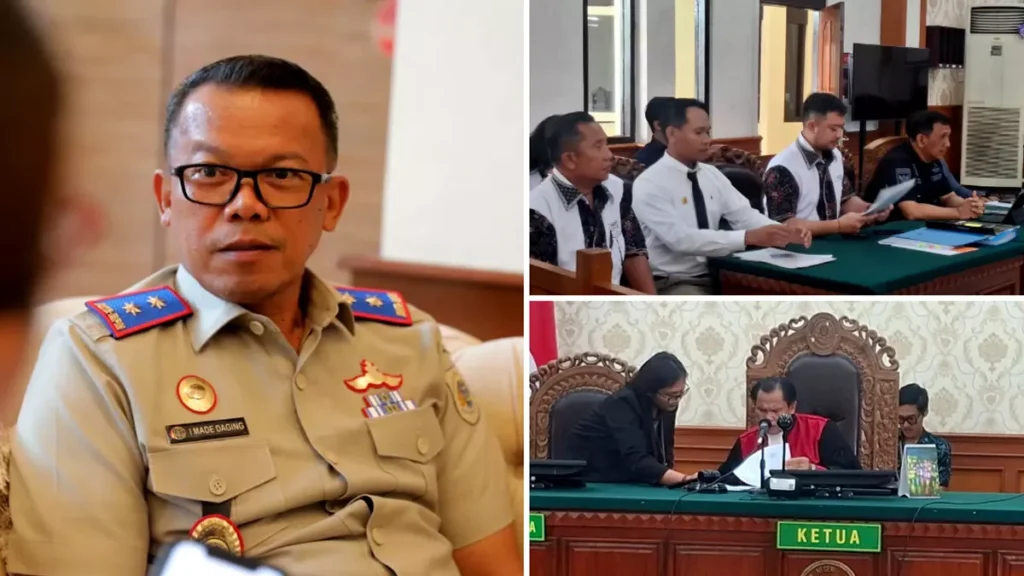
It arrived in a simple bowl on a quiet evening last January, long after the bureaucracy of land titles and office politics had receded into the tropical night. I was in the offices of the Bali Regional Land Agency, but this was no official meeting. The man across from me, I Made Daging, the agency’s chief, was by then a named suspect in a criminal investigation—a label that hangs in the Indonesian air with unique, suffocating weight. Yet here he was, offering soto ayam.
“Ini langsung ibu yang buat,” he said. My wife made this. The broth was rich, the meat tender. In that gesture—the offering of a wife’s homemade meal in the belly of a besieged institution—lay a quiet manifesto. This was not a man preparing for battle, but a man anchored in a world that persists beyond the headlines.
I.
In the weeks prior, the case had unfolded as these cases do in Indonesia: with official letters, police statements, and the slow, grinding gears of legal process. By December 2025, Daging wore the formal, freighted title of tersangka. A month later, the storm clouds had not parted. Most public figures, when caught in such a gale, adopt one of two postures: the defiant roar of the wronged, or the silent retreat of the shattered.
Daging chose a third way. He came to work.
When pressed on how he endured, his initial answer felt, to my journalistic ear, disconcertingly simple. “I have God. I believe in Him, and I surrender everything to Him.” It was the kind of statement one files away as polite evasion. But in Bali, faith is not an abstract refuge; it is a daily, architectural practice. I began to trace its outlines. His visits to temples in Nusa Penida and across the island were not pilgrimages of publicity, but journeys of recalibration. His public statements were studies in mundane duty: “My principle is, until today, I continue to carry out my task of serving the public.”
This was not stoicism. This was something more profound, and specifically Balinese.
II.
To understand his composure, one must step outside the language of law. Balinese Hinduism offers a different blueprint for weathering catastrophe—a way of seeing that turns crisis into context.
The world is understood through Rwa Bhineda: the perpetual, necessary dance of opposites. Light does not vanquish shadow; it defines it. A crisis, therefore, is not an aberration but a feature of the cosmic rhythm—a high tide in the soul’s ocean. To be thrown is to misunderstand the nature of the sea.
When the wave hits, the instinct is not outward blame but inward gaze—Mulat Sarira. This is the discipline of self-reflection, an audit of one’s own Karmaphala, the causal seeds sown in past actions. It is an acceptance of agency within a vast, incomprehensible design. This acceptance is the antithesis of passivity; it is the foundation of clear-eyed action.
That action is guided by Catur Purusa Artha, the four aims of a complete life. In Daging’s response, we see their alignment: Dharma (adherence to righteous duty, hence serving the public despite the scandal); Artha (the responsible management of his office’s worldly function); Kama (the mastery over destabilizing emotions like fear or anger); and Moksha (the orientation toward spiritual release, evident in his surrender).
His temple visits are his Melukat—ritual cleansings not to erase the problem, but to purify the instrument that must address it. His faith, his Sradha, is the final, crucial release valve. After one has done all one can, the outcome is surrendered. This surrender is not defeat; it is the spiritual mechanics that prevent a soul from collapsing under the weight of uncertainty.
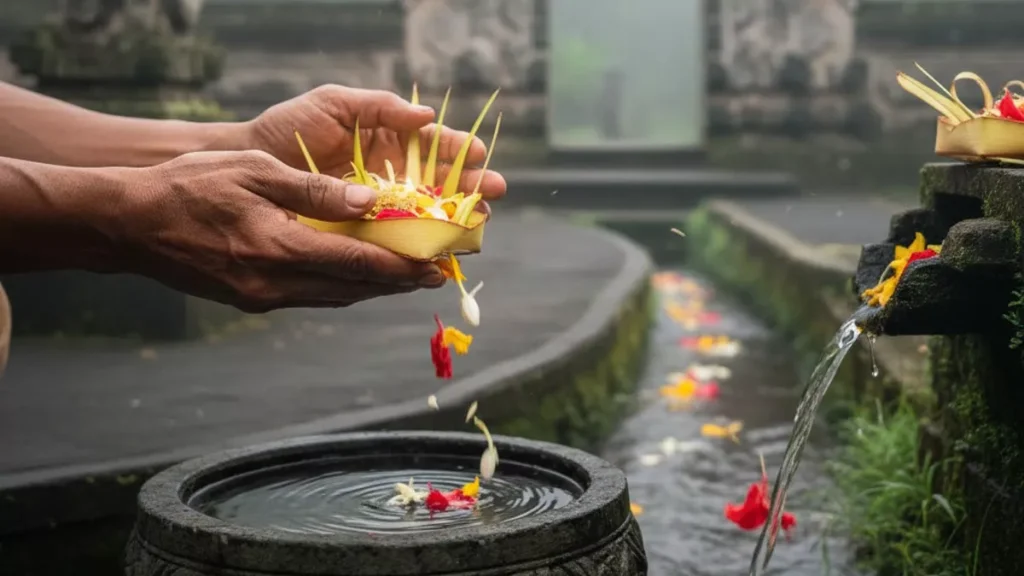
Illustration photo of canang sari offering as a symbol of surrender to divine power
III.
This is where the soup returns, brimming with meaning. The Western archetype of the embattled leader is often a solitary silhouette against the horizon. The Balinese archetype is inseparable from its web. Daging’s steadiness is not a solo performance but a chord struck within a family, a lineage (Purusa). The wife who cooks, the household that holds firm—this is the private sanctum that makes public composure possible. His dignity is an offering to his ancestors as much as a statement to his detractors.
For the global citizen observing from afar—the expatriate, the traveler, the investor—this is a critical, often missed, dimension of Bali. The island’s true resilience is not just in its coral reefs or volcanic soil, but in this psychological and spiritual infrastructure.
The case of I Made Daging will be decided in courts of law. But his posture has already delivered a verdict. In an age of perpetual outrage and performative victimhood, he demonstrates a radical alternative: that true strength can look like quietness, that duty can be a form of defiance, and that sometimes, the most powerful way to face life’s hardest storms is to ensure the lamp within your own house remains steadily, unshakably, lit.
#heybalinews #giostanovlatto