



































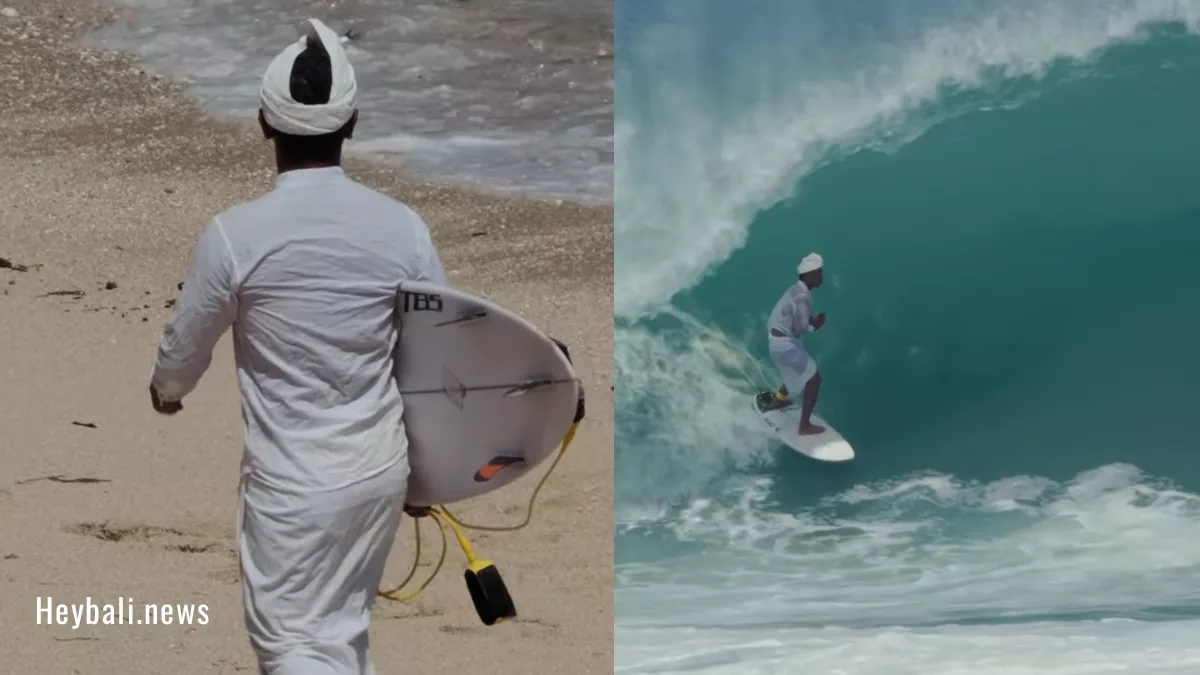
PADANG PADANG, BALI — At one of the world’s most demanding surf breaks, where even seasoned professionals tread carefully, a local Balinese surfer delivered a moment that felt both daring and deeply symbolic. Clad not in a wetsuit, but in full traditional Balinese attire, he paddled into the powerful waves of Padang Padang and emerged riding clean, hollow barrels with calm precision.
Captured in a 25-second vertical video, the scene quickly stands out against the usual imagery of high-performance boards and branded surf gear. This was something different. This was Bali, speaking in its own language.
The footage opens with the surfer walking barefoot across the sand and damp limestone rocks, surfboard under his arm. He is dressed entirely in white: a traditional shirt, kamen and saput wrapped neatly at the waist, and a white udeng secured on his head. It is attire more commonly seen at temples and ceremonies than at a wave often referred to as the “Pipeline of Bali.”
Moments later, the setting shifts offshore. The surfer drops into a thick, emerald-green Padang Padang wave, disappearing briefly into the barrel before re-emerging with control and confidence. The contrast is striking. White ceremonial fabric against deep blue water and foaming surf creates a visual that feels almost cinematic. In the final seconds, he continues carving along the wave face, his movements fluid, unbothered by clothing that would challenge most surfers.
Beyond the spectacle, the act carries meaning.
For Balinese Hindus, the ocean is not merely a playground. It is a sacred space tied to spiritual balance and respect for nature. White ceremonial clothing is traditionally worn during prayers and rituals, symbolizing purity and reverence. By entering the sea dressed this way, the surfer is not making a gimmick. He is making a statement.
Padang Padang is unforgiving. Its shallow reef, fast take-offs, and heavy barrels demand skill, timing, and courage. Choosing this wave, of all places, underscores that the performance was intentional, not symbolic theater. It was a demonstration of mastery, both physical and cultural.
In Bali, the concept of Tri Hita Karana emphasizes harmony between humans, nature, and the spiritual realm. This brief video captures that philosophy in motion. Surfing becomes more than sport. It becomes expression, identity, and dialogue with the sea.
At a time when Bali’s surf culture is often packaged for global consumption, moments like this cut through the noise. They remind viewers that for local surfers, the waves are not separate from tradition. They are part of it.
And for 25 seconds at Padang Padang, tradition rode the barrel.
Reported by Ferry Fadly
Written by Hey Bali Newsroom