






























DENPASAR, Bali — In a recent interview that has circulated widely across Indonesian social media, the public intellectual Rocky Gerung issued a stark warning. Indonesia, he argued, is approaching a moment of economic and political frustration that could peak as early as February 2026. His remarks touched on thinning state coffers, weakening purchasing power, eroding investor confidence, and a political elite, in his words, running out of room to maneuver.
While the comments originated in Jakarta’s political discourse, their implications extend far beyond the capital. For Bali—an economy deeply tied to consumption, tourism, and global confidence—such warnings carry immediate and tangible weight.
February as a Pressure Point, Not a Prophecy
Gerung’s focus on February is less symbolic than structural. In Indonesia, the early months of the year are often fiscally awkward. New budget allocations typically gain traction only after the first quarter, while large expenditures have already been made at the end of the previous year. At the regional level, including in Bali, delays in disbursement can tighten liquidity for local governments and businesses alike.
Official data shows that budget absorption in January and February tends to lag, even as household spending pressures rise ahead of Ramadan. Gerung frames this convergence as a temporary fiscal vacuum—one that, if paired with weakening consumer confidence, could amplify political and economic tension.
A Consumption-Led Model Under Strain
Gerung’s assertion that Indonesia’s growth relies heavily on household consumption broadly aligns with official statistics. Consumption has long been the backbone of the national economy.
The vulnerability of this model becomes apparent when purchasing power weakens. Wage growth has struggled to keep pace with living costs, while food and energy prices remain politically sensitive. Retail closures, cautious bank lending, and rising stress in certain credit segments point to underlying fragility.
For Bali, where spending on hospitality, dining, and discretionary services is closely linked to both domestic tourists and middle-class confidence, even a modest contraction can be quickly felt on the ground.
Debt, Confidence, and the Flow of Capital
Gerung does not reject borrowing outright. Instead, he situates it within a global environment marked by higher interest rates and selective capital flows. In such conditions, borrowing costs depend less on need than on credibility.
Indonesia’s debt-to-GDP ratio remains relatively moderate. Yet investor confidence is fluid. Political uncertainty or mixed reform signals can alter perceptions rapidly. In Bali, shifts in sentiment are often visible through cooling interest in property, hospitality projects, and long-term investment—sectors highly sensitive to global confidence.
Official Optimism and Lived Experience
Successive governments have emphasized optimism as an economic and political necessity. But optimism that is not reflected in everyday experience risks losing credibility.
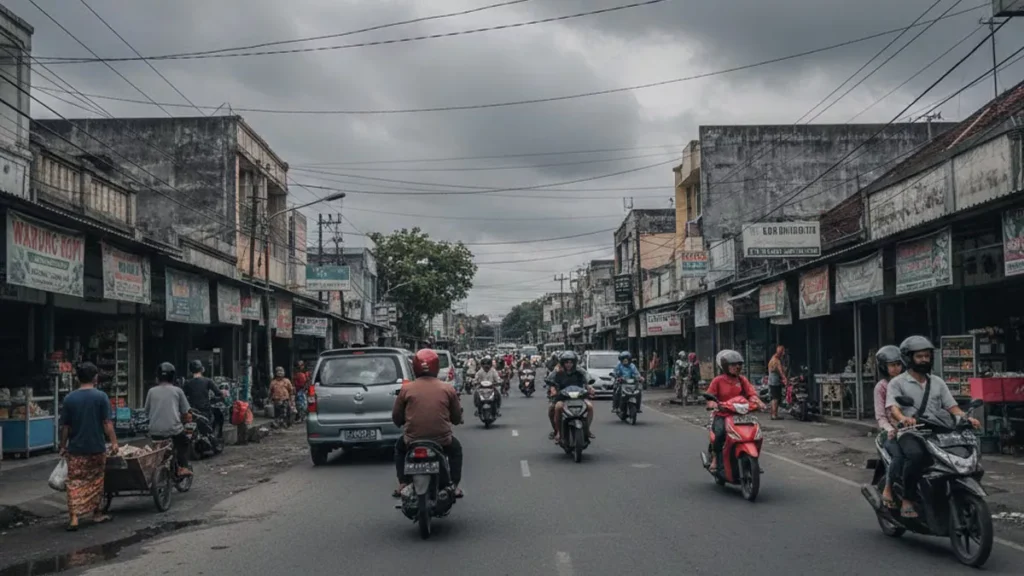
When official narratives point to stability while households grapple with rising costs, job uncertainty, or tighter credit, frustration tends to surface. In Bali, where livelihoods are closely tied to visitor flows and discretionary spending, this gap between macro indicators and daily reality can widen quickly.
An Alarm Heard on the Island
Gerung’s remarks are not a technical forecast. They are an alarm, intentionally provocative and broadly framed. Some claims rely on generalization and would require deeper empirical scrutiny.
Still, dismissing them outright would miss their resonance. Alarms often sound not because collapse is imminent, but because unease has taken root.
For Bali, this national debate is not abstract. A downturn in domestic purchasing power affects Indonesian tourism. A shift in global investor sentiment cools capital inflows. Fiscal uncertainty tightens local liquidity. In that sense, Gerung’s warning functions less as prophecy than as a lens—one that helps illuminate the vulnerabilities and resilience of the ecosystem that sustains life and business on the Island of Gods.
Below is the interview clip in which Rocky Gerung outlines his concerns. The views expressed are his own and are presented here to provide context for the analysis above.
#heybalinews #giostanovlatto