






















GIANYAR, Bali — The irrigation channels of Bali were designed to carry water to rice fields, not sea turtles.
Yet at dawn on Monday, in the farming village of Keramas, a protected olive ridley sea turtle was found swimming in a narrow irrigation canal hundreds of meters from the shoreline — a discovery that has left villagers, police, and conservationists searching for answers.
The turtle was alive.
How it arrived there remains a mystery.
The unusual discovery was made shortly after 6 a.m. by a local resident, I Wayan Eka, who had walked to the Subak Umadewa irrigation canal along Jalan Kurusetra in Banjar Gelgel, Keramas Village.
He was preparing for a morning bath when he noticed something moving in the water.
It was not a fish.
Nor was it one of the freshwater animals occasionally found in Bali’s agricultural waterways.
Instead, staring back at him was a sea turtle — a species that belongs in the ocean, not in a freshwater canal surrounded by rice fields.
Realizing immediately that the animal was out of place, Eka alerted local community leaders, who then notified authorities.
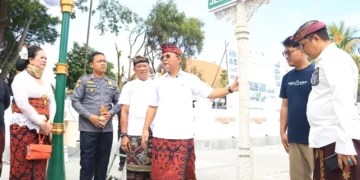
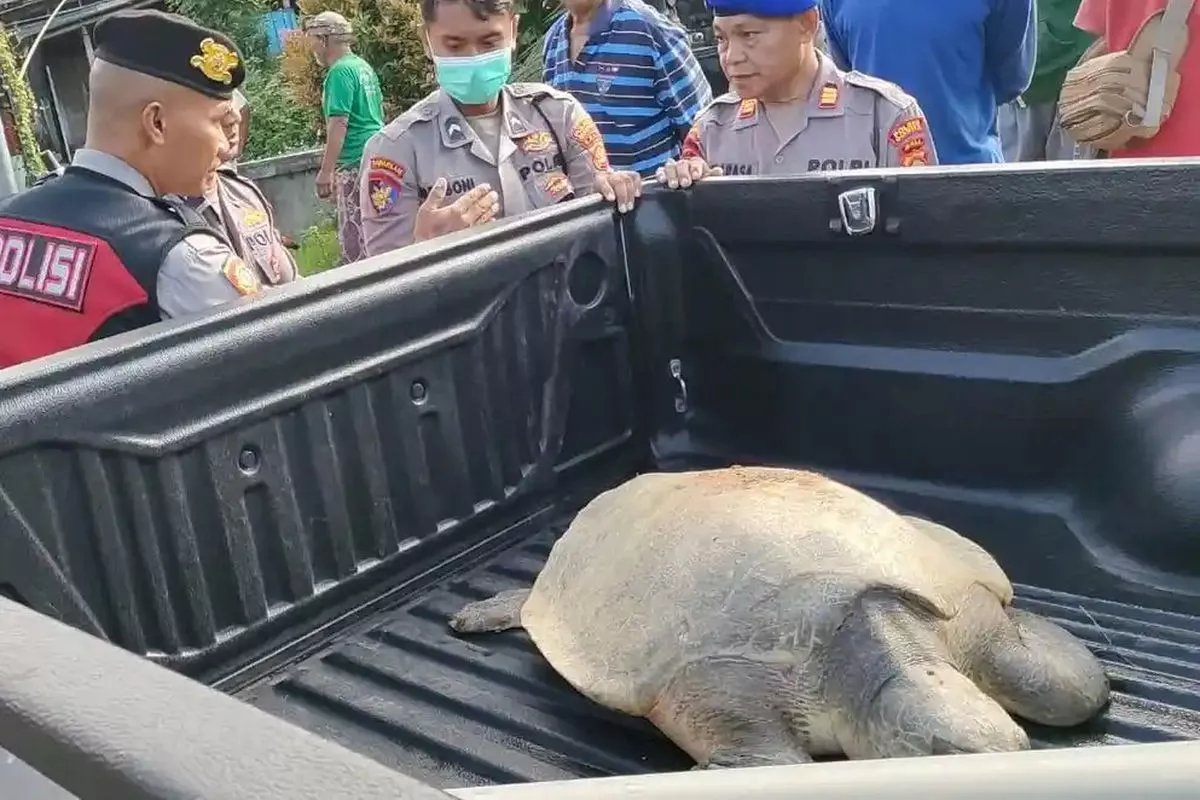
Within hours, officers from Blahbatuh Police and the Gianyar Water and Air Police Unit arrived at the scene.
The turtle, identified as an olive ridley sea turtle (Lepidochelys olivacea), was carefully removed from the canal and transported to the Saba Asri Turtle Conservation Center in nearby Saba Village, where it is now undergoing observation and care.
A Journey No One Can Explain
The rescue itself was straightforward.
The bigger question is how a protected marine animal ended up inside one of Bali’s centuries-old irrigation systems.
The canal where the turtle was discovered forms part of the island’s traditional subak network — an intricate system of waterways recognized by UNESCO as a World Heritage cultural landscape.
While these channels are connected to rivers and water sources that ultimately flow toward the sea, finding a sea turtle inside one remains highly unusual.
Authorities conducted an initial investigation, interviewed witnesses, and examined the area.
No evidence was found suggesting that local residents had been keeping the turtle.
“There is currently no indication that the animal was being maintained by residents in the area,” investigators noted during preliminary inquiries.
That leaves a number of unanswered possibilities.
Did the turtle somehow enter a river system before becoming trapped inland?
Was it carried by strong currents during rough sea conditions?
Or was it moved by human activity before eventually being abandoned?
For now, officials say there is not enough evidence to determine what happened.
A Protected Species in Need of Care
The olive ridley sea turtle is one of the world’s most widely distributed sea turtle species, found across tropical waters from the Indian Ocean to the Pacific.
In Indonesia, however, all sea turtle species are protected by law due to decades of pressure from habitat loss, accidental capture, marine pollution, and illegal wildlife trade.
Because of that protected status, the response involved more than a simple wildlife rescue.
Police have coordinated with the Bali Natural Resources Conservation Agency (BKSDA) and Indonesia’s Ministry of Marine Affairs and Fisheries (KKP) to assess the turtle’s health and determine the most appropriate conservation measures.
Veterinary examinations and monitoring are expected to continue before any decision is made regarding a possible release back into the wild.
A Reminder of Bali’s Hidden Wildlife
For many visitors, Bali is defined by beaches, temples, and rice terraces.
Yet beneath that image lies an island connected to one of the most biologically diverse marine ecosystems on Earth.
Sea turtles regularly nest on several beaches around Bali and neighboring islands. Conservation groups have spent decades protecting nesting grounds, rehabilitating injured animals, and reducing threats from poaching and plastic pollution.
Still, even veteran conservationists rarely expect to encounter a sea turtle in an irrigation canal designed for agriculture.
That is what makes Monday’s discovery so remarkable.
Somewhere between the ocean and a rice field, a protected marine reptile took a wrong turn.
Whether the answer lies in natural currents, human interference, or something else entirely remains unknown.
For now, the turtle is safe.
The mystery remains.
And in a place where ancient irrigation systems and marine wildlife exist side by side, the discovery serves as a reminder that Bali’s most surprising stories often emerge where land and sea unexpectedly meet.