



































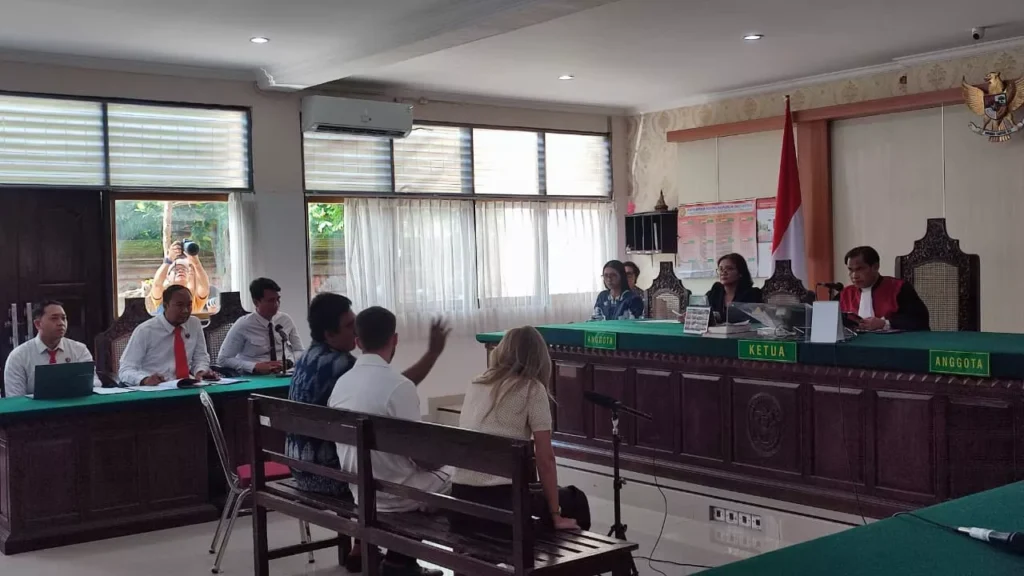
DENPASAR — “The court hereby sentences the defendants to a fine of Rp 200,000, to be replaced by one month of detention if unpaid.” With that brief ruling, Judge I Ketut Somanasa closed the case of Bonnie Blue in the Denpasar District Court on Friday (12/12/2025).
The outcome was a sharp contrast to the noise that echoed in the early days of the investigation. What once sounded like a serious criminal matter carrying a potential 15-year sentence under Indonesia’s pornographic and immigration laws ended as a Bali Legal Controversy centered on a minor traffic violation. The abrupt shift raises a deeper question about how law enforcement communicates and how quickly public narratives can collapse under scrutiny.
The defendants, Tia Emma Billinger — better known as Bonnie Blue (26) — and Jakson Liam Andrew (23), were found guilty not of producing pornographic material or misusing their visas, but of operating a pickup truck labeled “Bang Bus Bonnie Blue” on public roads in a way that violated Indonesia’s traffic regulations. The truck was eventually returned to them.
From Social Media Clip to Courtroom
According to the indictment read out in court, the case did not begin with direct surveillance or a formal investigation. Instead, it started when officers from the Badung Police noticed activity on Bonnie Blue’s Instagram account. Testimony later confirmed that the initial report was triggered when a police unit chief “only learned about it from TikTok.”
“The officers then secured the individuals and the vehicle for further examination at Badung Police headquarters,” the indictment stated.
This sequence highlights a modern paradox. Content designed to go viral ended up prompting formal action, yet as the investigation progressed — with 20 individuals initially questioned and equipment ranging from cameras to condoms seized — the case steadily shrank. Badung Police Chief AKBP M Arif Batubara publicly stated that “the elements of pornography have not been met” after intensive review.
When Narratives Collapse
The closing chapter of this Bali Legal Controversy leaves more questions than answers. How did a sweeping police operation framed with dramatic language devolve into a small administrative charge? And what does that mean for public trust?
Giostanovlatto, a Bali-based tourism analyst, views the case through the lens of reputation management. “This sets a troubling precedent for the Bali brand,” he said. “The world won’t remember a Rp 200,000 fine. What sticks is the impression that a supposedly major case evaporated or that a minor issue ballooned into an international spectacle. Both perceptions undermine the idea that Bali is a well-managed, serious destination.”
His assessment underscores a point often overlooked in fast-moving legal stories: the global audience does not judge cases only by the final ruling. They judge by the narrative that reaches them first — and by how coherently authorities communicate the facts.
A Test for Law Enforcement in the Viral Era
The Bali Legal Controversy surrounding Bonnie Blue offers several lessons. First, public communication from law enforcement needs discipline and proportionality. Any statement given at the height of public attention must be grounded in strong evidence, not shaped by the urgency of online momentum.
Second, Bali operates under global scrutiny. Every move by local authorities influences not only the fairness of a single case, but the broader image of an island dependent on trust, safety, and predictability.
“The biggest challenge isn’t managing tourists,” Giostanovlatto said. “It’s managing the legal narrative in a world that reacts before the facts mature. When authorities respond to viral pressure instead of leading with solid findings, the result is a confidence deficit — both for locals who feel their norms are at stake and for global travelers watching whether Bali is truly in control.”
A coordinated, evidence-driven approach will be essential for avoiding similar fractures in the future.
In the end, the Rp 200,000 fine may have settled Bonnie Blue’s traffic violation, but the broader Bali Legal Controversy now tests something far more valuable: the credibility of Bali’s legal system and the resilience of its tourism image. The public is waiting for clearer procedures and steadier communication — foundations that matter far more than the fleeting glare of a viral spotlight.
Reported by Ferry Fadly
Written by Hey Bali Newsroom