
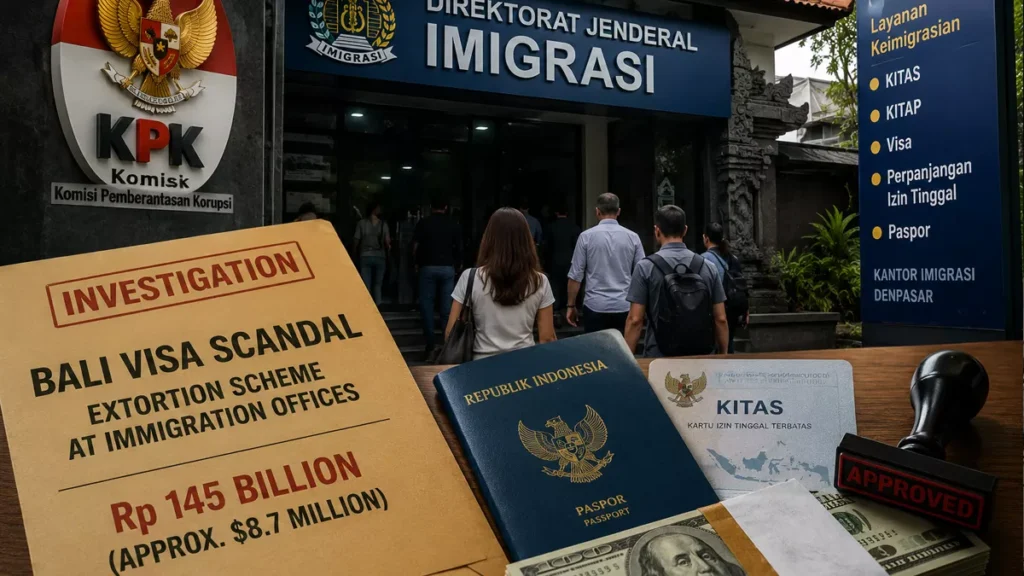
DENPASAR, Bali – Indonesia’s anti-corruption commission has intensified its investigation into an alleged extortion network operating within the country’s immigration directorate, questioning two more visa agents in Bali on Friday as evidence mounts of a systematic “pay-to-click” scheme that allegedly extracted millions of dollars from foreign nationals seeking residence permits.
The Corruption Eradication Commission (KPK) summoned Ni Komang Yustarin, a staff member of PT Bali Soft, and I Gusti Ngurah Putu Atmadja, both visa processing agents, for questioning at the Denpasar Police headquarters. Investigators are focusing on allegations that immigration officials at the Ngurah Rai and Denpasar offices demanded payments beyond official state levy rates—and that applications would be deliberately stalled if the extra fees were not paid.
“If the agents did not provide the additional money, the applications would not be processed—whether for KITAS, KITAP, IKT, or VOA,” said KPK spokesman Budi Prasetyo in a statement on Friday.
A Price Tag for Every Click
The investigation, which has already led to the detention of Deputy Minister of Immigration and Corrections Silmy Karim and seven other immigration officials, has uncovered a deeply entrenched system of corruption. According to the KPK, fees ranging from 100,000 to 2.5 million rupiah (approximately $6.50 to $160) were demanded for each document processed, with payments made weekly—often on Fridays—to distribute proceeds among officials.
The corruption, which allegedly persisted from 2022 through mid-2026, is estimated to have generated at least 145.5 billion rupiah (approximately $9.5 million) in illicit funds. These payments were disguised through a sophisticated layering system, with officials using coded language to conceal the transactions.
“Those involved used terminology such as ‘angel’ to represent distributions to senior officials, and terms like ‘vocalist,’ ‘guitarist,’ and ‘backup vocalist’ to mask payments to various parties,” Budi revealed earlier this week.
High-Profile Detentions
The case took a dramatic turn on June 4 when the KPK formally detained Silmy Karim, who served as Director General of Immigration from 2023 to 2024 before his appointment as Deputy Minister. Alongside him, seven other immigration officials have been named as suspects and are currently in custody.
Among those detained are Saffar Muhammad Godam, the Acting Director General of Immigration for 2024-2025; Jaya Saputra, former Director of Residence Permits and Immigration Status who now serves as Head of the West Java Regional Office; and several other mid-level officials accused of executing the extortion scheme.
According to KPK Chairman Setyo Budiyanto, the modus operandi was systematic: applicants were deliberately refused or delayed unless they paid additional fees at verification counters—first at regional immigration offices, then again at the central directorate in Jakarta.
“Applicants were forced to pay extra fees at the verification counters, and again at the Directorate General to ensure their applications were processed,” Setyo explained in a press conference.
A Culture of Extortion
The investigation has painted a damning picture of institutionalized corruption within Indonesia’s immigration apparatus. The KPK alleges that Silmy Karim, through his subordinate Jaya Saputra, directed Tessar Bayu Setyaji and Bagus Bramantyo—both subdivision heads at the Directorate of Residence Permits—to extract “extra fees” from foreign nationals, effectively institutionalizing the “every click has a price” culture.
To execute the scheme, the officials allegedly granted access to Juniadi Sri Priambudi and Gusti Benardiansyah, who managed nominee bank accounts to collect and launder the proceeds. The funds were then funneled to various officials, with Silmy Karim reportedly receiving a regular weekly allocation of 100 million rupiah (approximately $6,500).
The illicit proceeds, investigators said, were used for personal expenses, asset purchases, and even business ventures—including the establishment of a towing company designed to further obscure the money trail.
Implications for Expats and Travelers
For the thousands of expatriates, digital nomads, and retirees navigating Indonesia’s complex immigration system, the revelations confirm what many have long suspected: that the process of obtaining and renewing residence permits has been plagued by unofficial fees and arbitrary delays. The case has also drawn attention from diplomatic missions in Jakarta, many of which have expressed concern over the treatment of their citizens in visa-related matters.
The KPK has signaled that its investigation is far from over, with more witnesses expected to be called in the coming weeks. The commission has also established channels for whistleblowers and affected parties to come forward with information.
For expats and visitors: The KPK encourages anyone with relevant information about irregular practices in visa processing to contact the commission through its official channels. The investigation remains active, and further arrests or charges have not been ruled out as authorities work to dismantle what appears to be a deeply embedded network of corruption within Indonesia’s immigration system.