

BADUNG, Bali — A Swiss national who sparked widespread outrage after posting a profanity-laced message about Nyepi, Bali’s sacred Day of Silence, remains in police custody as authorities move forward with a hate speech case under Indonesia’s criminal code.
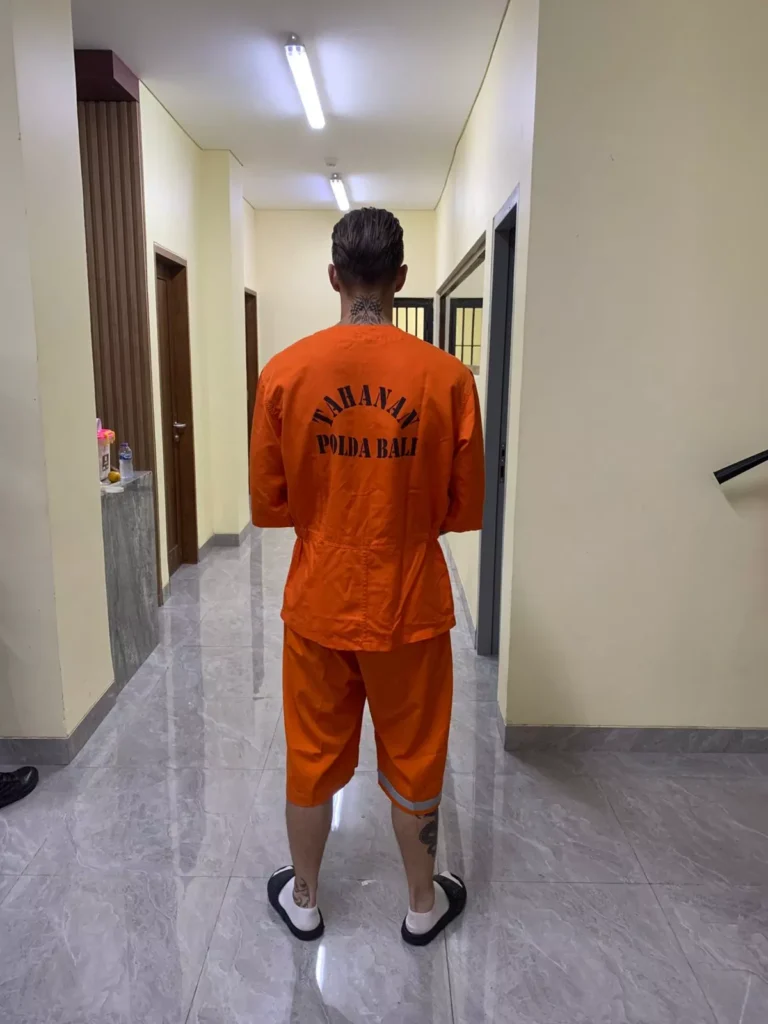
Luzian Andrin Zgraggen has been held at the Bali Police detention facility since being formally named a suspect, police said on Tuesday.
“He is currently detained at the Bali Police detention center,” said Ariasandy, the head of public relations for Bali Police, speaking in Nusa Dua.
The case, which began as a routine cyber patrol, has quickly evolved into a high-profile legal test of how Indonesia enforces laws on religious insult in the digital age—particularly when foreign nationals are involved.
A Post That Crossed a Line
According to investigators, the case originated when Bali Police’s cyber unit identified an Instagram Story posted from the account @luzzysun.
In the post, Zgraggen described Nyepi as “a day of silence” before ending with an explicit remark dismissing both the holiday and its rules—language that many in Bali viewed as deeply offensive.
The message spread rapidly across Indonesian social media, triggering a wave of condemnation from Balinese Hindus and the wider public.
Within hours, authorities had traced the account to Zgraggen and began efforts to locate him on the island.

From Online Post to Criminal Charges
Police say the legal threshold for prosecution has been met.
Zgraggen has been charged under Article 301 (1) of Indonesia’s 2023 Criminal Code, which governs the dissemination of content containing insults through electronic media. Investigators determined that the post, shared via Instagram, fulfilled the elements required under the law.
He also faces charges under Article 300 (b), which addresses expressions of hostility or hatred toward groups based on religion or belief.
Taken together, the charges reflect Indonesia’s firm legal stance on religious harmony—particularly when expressions of insult are amplified through digital platforms.
“The report has been followed up, and the suspect has been formally named,” Ariasandy said.
A Sacred Day, A Legal Boundary
Nyepi is one of Bali’s most significant religious observances. For 24 hours, the island comes to a complete standstill: flights are grounded, streets are emptied, lights are dimmed, and residents—along with visitors—are expected to remain indoors.
The day is not symbolic. It is enforced.
Indonesia’s legal framework recognizes and protects such observances, and the law extends not only to physical violations but also to expressions—online or otherwise—that are deemed to insult or undermine religious practices.
For foreign visitors, this creates a legal context that may differ sharply from norms in other countries, where similar expressions might fall under protected speech.

A Case with Broader Implications
Zgraggen remains in custody as the case proceeds toward prosecution. Authorities have not indicated when the case will move to court, but the investigation phase is ongoing.
Beyond the individual case, the incident is being closely watched as an example of how Indonesia’s updated criminal code is applied in an increasingly digital and globalized environment.
It also highlights the speed at which online expression can move—from a fleeting post to a matter of criminal law.
More Than a Local Issue
For Bali’s international community, the case underscores a broader reality: that the island’s cultural and religious practices are not simply part of its identity, but are embedded within its legal structure.
What may appear, elsewhere, as personal expression can carry different consequences here—especially when it intersects with religion.
Where the Line Is Drawn
The case now moves forward within Indonesia’s legal system, but its significance extends beyond the courtroom.
It sits at the intersection of culture, law, and digital speech—raising questions not only about what was said, but about where the limits of expression are defined, and by whom.
For now, one thing is clear.
What began as a single social media post has become something far larger: a test of how far expression can travel before it meets the boundaries of law.