

BADUNG, Bali — A weakening rupiah is rarely just a currency story. For Bali’s expatriates and foreign investors, it quietly reshapes purchasing power, investment returns, and long-term financial planning.
With the rupiah hovering near the Rp 17,000 per US dollar level—a threshold not seen since the 2020 pandemic—the shift is becoming harder to ignore. For some, it creates opportunity. For others, it introduces new layers of risk.
The question is no longer whether the currency will fluctuate—it always has—but how individuals and investors structure their finances to navigate that volatility.
A Weaker Rupiah, A Different Financial Reality
Currency movements in Indonesia tend to ripple quickly through everyday life and investment performance.
- For those earning in rupiah, imported goods, international travel, and offshore savings become more expensive, reducing effective purchasing power.
- For those holding foreign currency, local assets—from property to services—become relatively cheaper.
- For property investors, rental income generated in rupiah translates into lower returns when converted into dollars or euros.
These dynamics are not new. What is different today is the broader macroeconomic backdrop shaping them.
Why Passive Strategies Are Being Tested
For much of the past decade, Bali’s property market rewarded a relatively simple strategy: acquire assets, hold them, and benefit from tourism-driven growth.
That approach is now being tested by a more complex environment:
- Global interest rate cycles have tightened liquidity across emerging markets
- Geopolitical tensions continue to drive capital toward safer assets
- Currency volatility is increasing across Southeast Asia
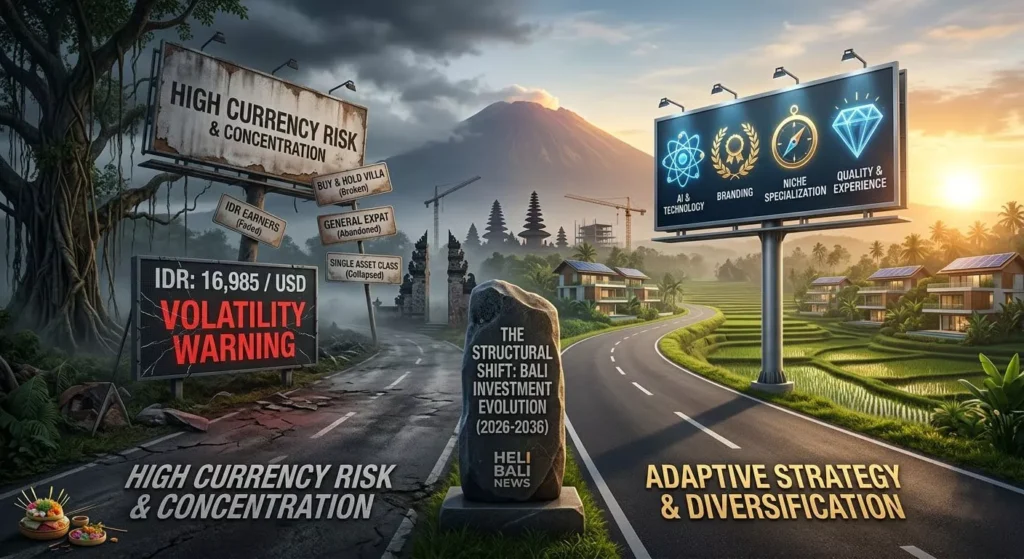
In this context, a purely passive “buy and hold” strategy may still work in prime locations—but it is no longer sufficient on its own for many investors seeking stable, currency-adjusted returns.
Shifting Investor Behavior: From Passive to Adaptive
Market participants are increasingly focusing on flexibility, liquidity, and diversification.
According to Jason Gozali, Head of Investment Research at Pluang, recent market movements reflect a broader shift in investor behavior.
“Periods of geopolitical uncertainty remind us that most risk assets are interconnected. Investors are becoming more selective—focusing on hedging strategies and assets that can preserve value during volatility,” he said.
This does not signal the end of traditional investments—but it highlights a growing preference for portfolio balance rather than concentration in a single asset class.

What This Means for Bali-Based Investors and Expats
For those living in or investing in Bali, the implications are practical and immediate.
1. Currency Exposure Matters More Than Before
If income is primarily in rupiah but financial goals are tied to foreign currencies, even modest depreciation can affect long-term outcomes.
Diversification—whether through multi-currency holdings or offshore assets—becomes a risk management tool rather than a luxury.
2. Property Returns Need a Closer Look
Bali property remains attractive, but returns should be evaluated more carefully.
A rental yield that appears strong in rupiah may look significantly lower when converted into dollars, particularly during periods of currency weakness.
3. Liquidity Is Becoming More Valuable
Unlike property, which is relatively illiquid, financial instruments offer flexibility during uncertain periods.
Some investors are exploring gold-linked or inflation-resistant assets as part of broader diversification strategies. However, these instruments also carry their own risks and require careful due diligence.
4. Adaptability Is Now a Core Strategy
The Bali market itself has not weakened—but the conditions around it have changed.
Strategies that worked five years ago may still work—but increasingly require adjustment through diversification, active management, and awareness of macroeconomic shifts.
A Practical Perspective for Investors
For Bali-based expats and investors, the current environment calls for awareness—not panic.
- Long-term residents should review currency exposure
- Property owners should stress-test returns
- New investors may find opportunities—but must remain disciplined
The Bottom Line
The rupiah approaching Rp 17,000 is not, in itself, a crisis.
It is a signal.
A signal that the global environment is shifting, that currency risk is no longer abstract, and that investment strategies—especially in markets like Bali—must evolve accordingly.
For those who adapt, volatility can present opportunity. For those who ignore it, it can quietly erode returns.
Disclaimer: This article is for informational purposes only and does not constitute financial advice. Investors should assess their own risk profile and consult qualified professionals before making financial decisions.