













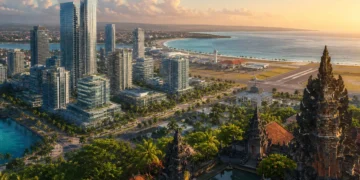




















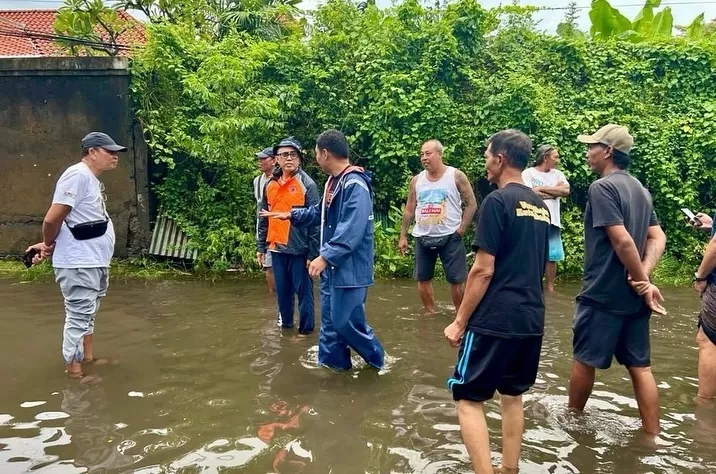
What unfolded on Thursday morning was more than a routine wet-season downpour. In Sanur, one of Bali’s oldest and most established tourism corridors, flooding once again disrupted daily life, exposing long-standing infrastructure weaknesses in an area central to the island’s visitor economy.
SANUR, BALI — Heavy rain early Thursday (January 8, 2026) turned several streets in Denpasar into shallow waterways, with Sanur bearing the brunt of the impact. The flooding, which followed weeks of intensified rainfall since December, underscored how vulnerable low-lying coastal districts have become as urban density, aging drainage systems, and extreme weather increasingly collide.
Residents say Jalan Bumiayu has long been a flood-prone area, but conditions have worsened noticeably in recent months. This week’s inundation spread to Jalan Danau Tamblingan, where water entered the grounds of Villa The Pavilions Bali, as well as Jalan Pungutan and surrounding streets.
“Sanur is indeed the worst-hit area here. This was originally a rice field, an absorption area, which is why the middle is low-lying,” said Made Adnyana, a technical staff member of the Bali Regional Disaster Management Agency (BPBD) and a Sanur resident, as quoted by detikBali. He added that tidal conditions further compound the problem. “According to the River Basin Office, seawater intrusion is also a factor. When high tide coincides with heavy rain, the water takes much longer to recede.”
Business Operations Disrupted
Beyond residential inconvenience, the flooding has become a recurring operational challenge for tourism businesses that anchor Sanur’s economy. At Sanur House, staff described how even moderate flooding can bring logistics to a halt.
“The problem is cars can’t enter, so we have to carry goods in by hand,” said Santi, a staff member. “It’s heavy. We manage with a trolley, but if you don’t have one, you have to lift things together.” She added that electrical short-circuiting, particularly from submerged garden lighting, is a frequent concern.
While floodwaters now typically recede within hours, an improvement from past incidents that lasted days, the reputational impact remains. “Guests definitely complain,” Santi said. “They ask why it’s flooded here when other areas aren’t. We explain it’s because of the construction and land contour.”
Swift Response, Short-Term Fixes
City authorities moved quickly. Denpasar’s Public Works and Housing Department (PUPR) and the Fire Department (Damkar) were deployed to pump water toward the nearest discharge point at Karang Beach, a process carried out after rainfall eased and tides dropped to prevent backflow into the basin.
The rapid response helped limit prolonged flooding, but it also highlighted a deeper issue: emergency pumping has become a routine solution to what is no longer an isolated problem. As rainfall patterns intensify and coastal pressure increases, these reactive measures offer relief without addressing the structural causes beneath Sanur’s streets.
One reason the flooding feels more severe now is the cumulative effect of heavier seasonal rain falling onto areas that have steadily lost their natural absorption capacity, as former wetlands and rice fields give way to roads, villas, and commercial buildings.
A City-Wide Pattern
Sanur was not alone. BPBD confirmed flooding across multiple parts of Denpasar, including Renon, Sumerta Kelod, Dauh Puri, Serangan, and Panjer. On Jalan Tukad Irawadi in Panjer, water entered homes where floor levels sit lower than the roadway.
Made Antara, head of the Emergency Control Unit at Denpasar BPBD’s Operations Control Center, confirmed the reports, pointing to a city-wide strain on drainage systems during peak rainfall.
A Pattern of Vulnerability
The flooding in Sanur reflects a broader challenge facing Bali as it balances rapid development with environmental limits. Beneath the island’s tranquil image lies an increasingly fragile urban landscape, where historical land use, coastal dynamics, and modern construction intersect under mounting climate pressure.
For residents, business owners, and the global community that lives in and visits Bali, the scene is becoming familiar. Emergency crews manage each episode, waters recede, and life resumes, until the next heavy rain exposes the same fault lines again.
In Sanur, where the past geography of wetlands meets the present reality of dense development, flooding has become a seasonal certainty. Long-term solutions remain elusive, leaving many to endure what locals now wryly describe as “langganan banjir” — a subscription flooding that returns with every rainy season.















Comments 1