

















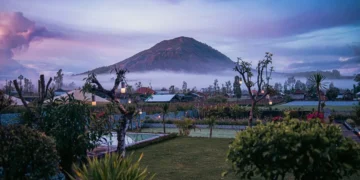

















BEDUGUL, Bali — On a typical day, the mist-shrouded waters of Lake Beratan would be lined with visitors from around the world, their cameras trained on the floating temple that has become one of Bali’s most photographed sites. But these are not typical days.
At Ulun Danu Beratan Temple, one of Bali’s most iconic destinations, the number of international visitors has dropped by half. Where 600 foreign tourists once arrived on an average day, now only about 300 come. The cause, according to site management, is not local. It is distant, geopolitical, and largely beyond the island’s control.
“The pressure on the foreign tourist sector is very heavy right now,” said Agus Teja Saputra, spokesperson for the site. “Global uncertainty is significantly reducing daily arrivals.”
A Temple That Reflects a Larger Vulnerability
Ulun Danu Beratan is more than a tourist attraction. It is a place of worship, built on the shores of a crater lake that has long been central to Bali’s irrigation system and spiritual life. Its pagoda-like shrines, rising from the water against a backdrop of misty mountains, have made it a symbol of Bali itself.
But its reliance on international visitors also makes it a bellwether. When global events disrupt travel, the effects are felt here—quickly and visibly.
The current dip, which began as tensions escalated in the Middle East, is one of the sharpest declines since the pandemic. And unlike the health crisis that kept visitors away for months, this disruption is tied to something less predictable: the closure of airspace, the rerouting of flights, and the creeping hesitation that follows when the world feels less stable.
Domestic Visitors Fill Some of the Gap—But Not All
As international numbers have fallen, domestic tourism has offered a partial lifeline. Since the long holiday period began around March 20, local visitor numbers have risen by about 30 percent, from an average of 700 to 1,100 per day.
But even that increase has not matched previous years. During the Lebaran holiday in 2025, daily domestic arrivals at the temple reached 2,000. This year, management says, the numbers are lower—in part because of broader economic pressures affecting household spending.
“The decline in domestic visitors compared to last year is about half,” Saputra said. “This year, there are almost no large groups or bus tours. Most visitors are independent families, mainly from East Java, Central Java, and West Java.”
A Strategic Shift
Facing a prolonged drop in international arrivals, the site’s management has shifted its promotional focus toward domestic markets, particularly in Java, where the majority of Indonesian tourists originate. The goal is to push daily arrivals to between 1,500 and 2,000 during the remaining holiday period, which is expected to last until March 28.
But even if that target is met, it would only partially offset the loss of foreign visitors—and it would not restore the international presence that has long been a defining feature of the site.
A Wider Story
Ulun Danu Beratan is not the only destination feeling the effects of global instability. Across Bali, tourism operators are reporting softer-than-expected international arrivals, particularly from Europe and the United States, where travelers face longer routes, higher fares, and the psychological weight of traveling through an uncertain world.
For now, the temple remains open. The prayers continue. The lake still reflects the sky. But the absence of the international visitors who once filled its grounds is a quiet reminder that even Bali’s most sacred spaces are not insulated from the world beyond.
What This Means for Travelers
For those planning trips to Bali, the situation at Ulun Danu Beratan reflects a broader pattern: international arrivals are down, but domestic tourism is holding steady. For visitors who do make the journey, the experience may be quieter than in previous years—with shorter lines, fewer crowds, and a different kind of atmosphere.
It is also a reminder that travel decisions are shaped by forces far beyond the destinations themselves. And for a place like Ulun Danu Beratan, whose beauty has drawn visitors for generations, the current slowdown is not a failure of its appeal—but a reflection of a world in which even the most distant conflicts can ripple across continents.
Hey Bali News continues to track the impact of global events on Bali’s tourism industry. For travelers, staying informed about changing conditions can help in planning visits that align with both personal preferences and the realities of the moment.