


































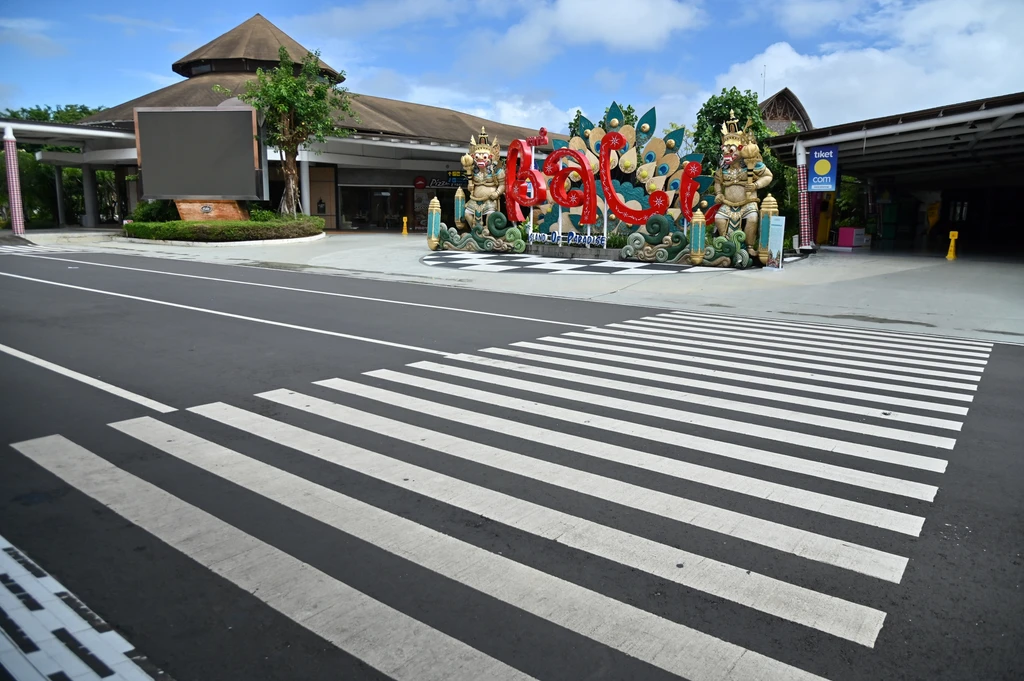
BADUNG, Bali — For millions of visitors arriving in Bali each year, the first experience of the Island of the Gods is no longer a sunset, a temple, or the scent of incense drifting through the air.
It is traffic.
Long lines of vehicles crawling toward the exit gates of I Gusti Ngurah Rai International Airport have become an increasingly familiar sight, prompting Bali Governor Wayan Koster to issue a public call for urgent improvements to the transport network serving the island’s main gateway.
Speaking during a transportation accessibility forum in Kuta on Monday, Koster warned that growing congestion around the airport is no longer a minor inconvenience. It has become a strategic issue that directly affects visitor comfort, mobility, and ultimately Bali’s reputation as one of the world’s leading tourism destinations.
“The flow of vehicles must be mapped comprehensively,” Koster said. “We cannot focus on only one congestion point. Every traffic movement around the airport needs to be properly analyzed.”
Sixteen Million Travelers. One Gateway.
The scale of the challenge is difficult to ignore.
According to the governor, more than 16 million passengers passed through Ngurah Rai International Airport during 2025. That figure included approximately 7.05 million international visitors and 9.2 million domestic travelers, making the airport one of Indonesia’s busiest transportation hubs.
Every arriving passenger must eventually enter the same road network that connects Bali’s most important tourism areas, including Kuta, Seminyak, Jimbaran, Nusa Dua, Sanur, Uluwatu, and Denpasar.
The result is a transportation system increasingly struggling to keep pace with demand.
For years, congestion around Bali’s southern tourism corridor has been treated as an unavoidable consequence of popularity. But as visitor numbers continue to climb, provincial leaders are beginning to acknowledge that traffic has evolved from a nuisance into a competitive challenge.
Bali’s greatest asset has always been accessibility. Visitors can land and be at a beach, resort, or villa within a relatively short distance. Yet that advantage begins to erode when short journeys stretch into lengthy delays.
A Symptom of a Larger Problem

The congestion surrounding Ngurah Rai Airport reflects a broader reality facing Bali.
Tourism arrivals have recovered faster than infrastructure expansion.
Over the past decade, hotels, villas, restaurants, beach clubs, residential developments, and tourism facilities have expanded rapidly across South Bali. Roads, however, have not grown at the same pace.
The airport now sits at the center of an increasingly complex transportation ecosystem that serves not only tourists but also workers, logistics operators, ride-hailing services, tour vehicles, and local residents.
As visitor numbers continue to rise, pressure on the network grows accordingly.
That is why Koster is pushing for solutions that go beyond isolated traffic management measures.
Rather than focusing on individual bottlenecks, he is calling for a comprehensive assessment of vehicle movement patterns throughout the airport corridor and surrounding tourism zones.
The governor also emphasized that discussions should not end as another government study.
“The recommendations must lead to concrete action,” he said.
Expansion Plans Back on the Table
Beyond road access, Koster also highlighted the need to accelerate plans for airport development.
Among the proposals being discussed are expanded parking facilities, improved terminal infrastructure, and broader efforts to improve passenger movement between air and ground transportation systems.
Such upgrades have been discussed for years, but the governor’s comments suggest growing urgency as Bali’s tourism recovery continues to exceed expectations.
For international travelers, airport accessibility increasingly forms part of the overall holiday experience. Long waits, transportation confusion, and traffic congestion can shape perceptions of a destination before visitors even reach their hotel.
A Challenge No Single Institution Can Solve
Officials acknowledge that solving the problem will require coordination far beyond airport management.
Ferry Kusnowo, Director of Strategy and Technology Development at PT Angkasa Pura Indonesia, said improving airport accessibility demands an integrated and collaborative approach involving multiple stakeholders.
“Strengthening transportation access to and from the airport requires an integrated, phased, and collaborative strategy,” he said.
That includes government agencies, airport operators, transportation providers, tourism businesses, and urban planners.
The challenge facing Bali is no longer simply how to attract visitors.
The island has already succeeded at that.
The challenge now is ensuring that the infrastructure supporting tourism grows quickly enough to keep pace with the success it has created.
Bali’s Next Test
For decades, Bali has overcome crises ranging from terrorist attacks and volcanic eruptions to a global pandemic. Each time, the island demonstrated remarkable resilience.
Traffic congestion presents a different kind of challenge.
Unlike natural disasters or temporary disruptions, congestion grows gradually. It is easy to tolerate until it becomes impossible to ignore.
Governor Koster’s intervention signals that Bali may be reaching that point.
With more than 16 million passengers moving through Ngurah Rai Airport annually, the question is no longer whether transportation improvements are needed.
The question is whether they can be delivered quickly enough to preserve the visitor experience that helped make Bali one of the world’s most beloved destinations in the first place.
Because in modern tourism, the journey begins long before travelers reach the beach.
It begins the moment they leave the airport.