























JEMBRANA, Bali – The turtle had already been dead for some time.
When residents spotted it on Yehembang Beach in western Bali, the smell had become impossible to ignore. By the time authorities arrived, the animal was lying motionless on the sand, another protected sea turtle lost before anyone could determine what happened.
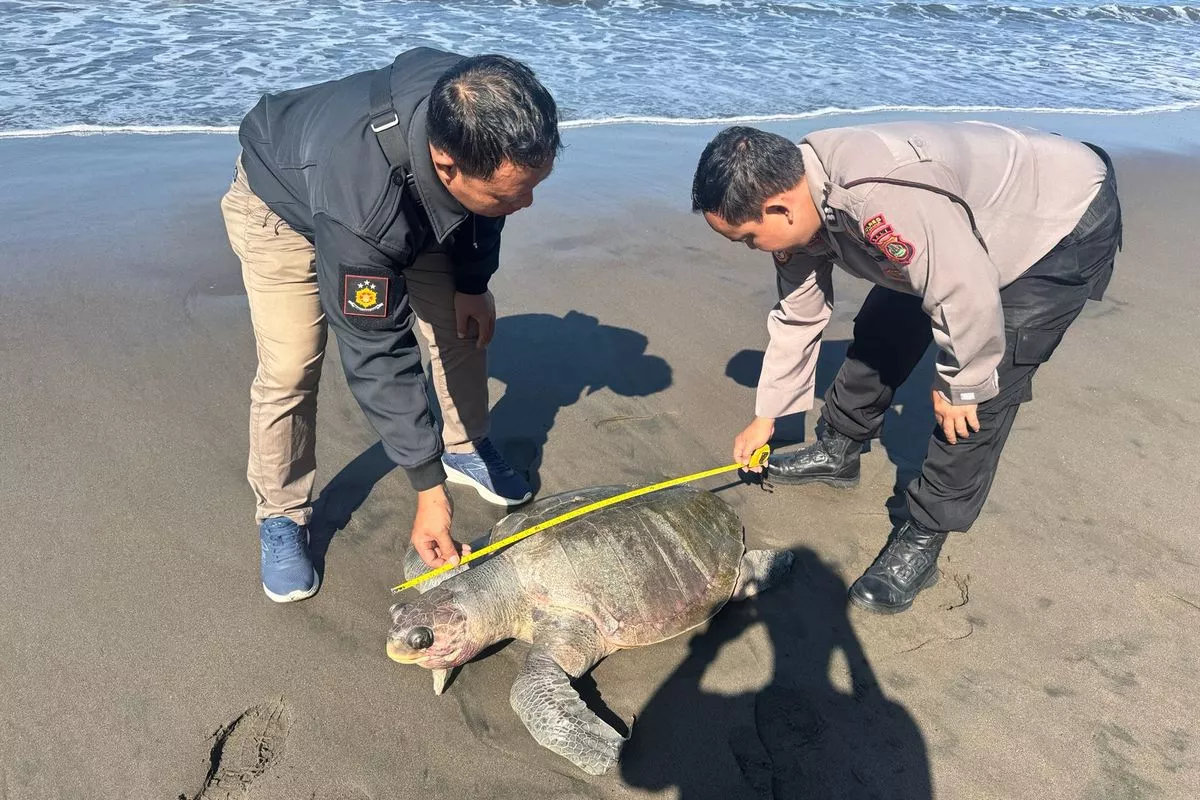
Police in Jembrana Regency received reports Tuesday morning of a dead olive ridley turtle (Lepidochelys olivacea) that had washed ashore along the coastline of Yehembang Village in Mendoyo District.
Local residents said the turtle had likely been stranded since Monday night.
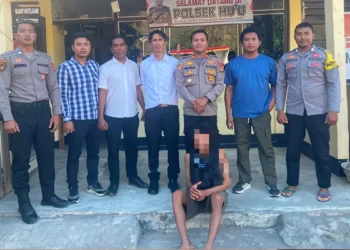
“We immediately went to the location to conduct an inspection and carry out initial handling,” said Mendoyo Police Chief Kompol I Wayan Sartika.
The turtle measured approximately 88 centimeters long and 62 centimeters wide.
Despite an external examination, officers found no visible wounds, injuries, or signs of trauma.
“When it was discovered, the turtle was already dead and emitting an unpleasant odor because it is believed to have been stranded for quite some time,” Sartika said.
Authorities later coordinated with the Marine Management Office in Denpasar and decided to bury the carcass near the discovery site.
The burial took place at approximately 10:30 a.m. with assistance from local residents.
Officials said the decision was made to prevent environmental contamination and potential health risks in the surrounding area.
The cause of death remains unknown.
A Familiar Discovery on Bali’s Shores
What happened at Yehembang Beach is not an isolated event.
Olive ridley turtles are among the most widely distributed sea turtle species in the world and are protected under Indonesian law. Globally, they are classified as vulnerable, facing increasing pressure from habitat loss, marine pollution, fishing activities, and changing ocean conditions.
Yet along Indonesia’s coastlines, dead turtles continue to appear with unsettling regularity.
Some are found entangled in fishing gear.
Others wash ashore carrying plastic waste in their digestive systems.
Many, however, reveal few obvious clues.
Without a necropsy — the animal equivalent of an autopsy — determining a precise cause of death becomes nearly impossible.
That leaves authorities, conservationists, and local communities with questions but few answers.
What the Sea Doesn’t Tell Us
The challenge with marine wildlife deaths is that the most important evidence is often invisible.
A turtle can travel hundreds of kilometers before currents carry it ashore.
The place where it is found may have little connection to the place where it died.
In this case, no external injuries were observed.
There were no obvious signs of boat strikes.
No visible evidence of entanglement.
No indication of what happened beneath the surface.
And once the turtle was buried, the opportunity to learn more largely disappeared.
Why It Matters
For many visitors, Bali’s beaches represent the island’s natural beauty.
For conservationists, they are also part of a fragile ecosystem that supports sea turtles, coral reefs, fisheries, and countless marine species.
Each dead turtle is a reminder that much of what happens in the ocean remains unseen.
Sometimes the cause is obvious.
Sometimes it is not.
The olive ridley turtle found at Yehembang Beach this week may never reveal what killed it.
By Tuesday afternoon, the animal had been buried in the sand not far from where it was discovered.
The mystery went underground with it.