



























DENPASAR – Three days into Bali’s bold experiment to shut its main landfill to organic waste, the scene outside Suwung tells a story of good intentions meeting messy reality.
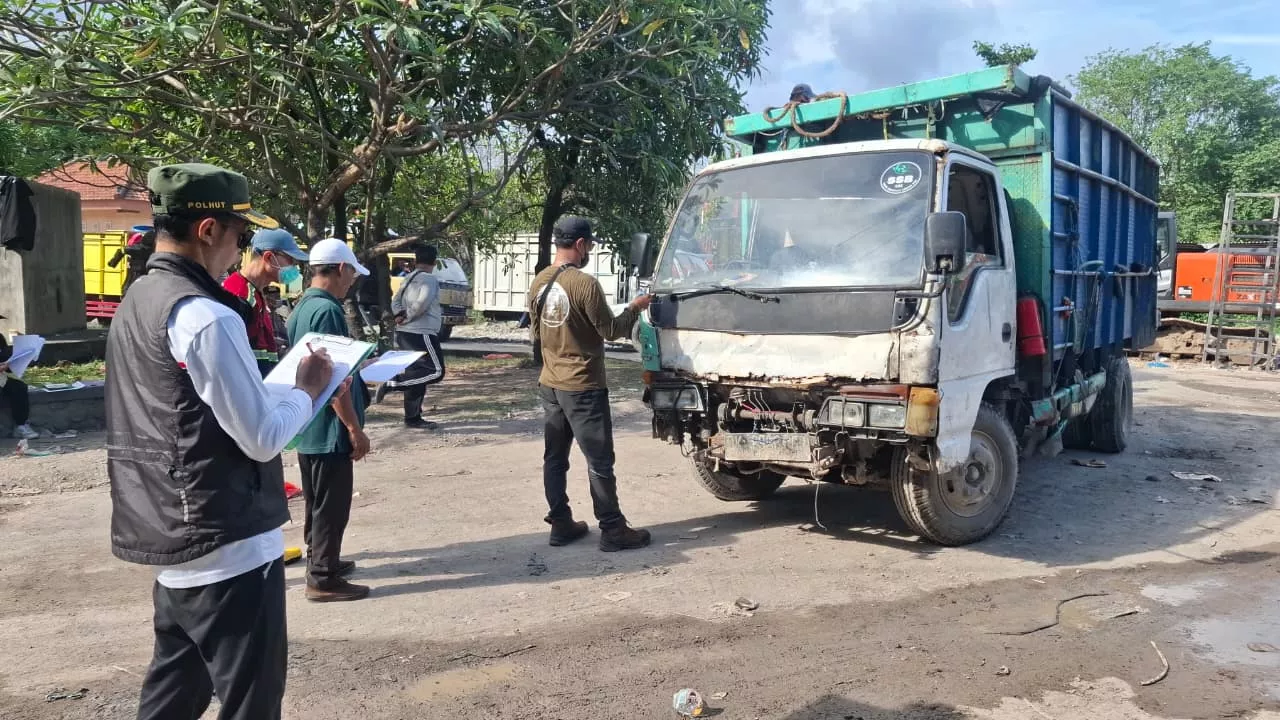
On Friday morning, April 3, 2026, dozens of garbage trucks lined the roads of South Denpasar. One by one, they crept toward the gate. One by one, most were sent back.
The policy, effective April 1, forbids Suwung from accepting any organic waste. Only anorganik (inorganic) and residu (residual, non-recyclable) material may enter. But on the ground, the line between “clean” and “contaminated” is proving difficult to draw.
No Tolerance, No Exceptions
I Putu Agus Juliartawan, Head of the Waste Management Unit at Bali’s Forestry and Environment Agency, was firm when speaking at the landfill Friday.
“If organic waste is found, we immediately order the truck to turn around,” he said.
There is no grace period. No warnings. No second chances at the gate.
To ensure compliance, a rotating team of environment agency officers works alongside police, military, and Satpol PP (municipal police) personnel. Officers change shifts every two hours. The inspection never stops.
Each truck that passes through—whether approved or rejected—receives written documentation from the officers.
The Driver’s Dilemma: An Orange Peel, A Bone, and A U-Turn
Ferdy, a driver from the Banjar Brawa waste management forum in Canggu, Badung, arrived at Suwung believing he had done his job.
“We already sorted everything before loading,” he told reporters. “But they still found a little bit of orange peel and some bones. They told us to go back.”
His story was not unique. Drivers across the region report spending hours sorting waste at source, only to be rejected for trace amounts of organic contamination.
Juliartawan offered no alternative. Trucks that fail inspection have only one option: return to the waste’s origin and sort again.
An Exhausted Official, A Missing Explanation
When reporters approached Made Dwi Arbani, Head of Bali’s Environment and Forestry Agency, at the landfill, his body language spoke louder than words.
His face appeared tired. Asked whether drivers understood that waste must be sorted before arrival, he gave a brief, almost defeated response:
“They should know by now.”
He then crossed his arms—a signal that he was done explaining.
For a policy this transformative, the absence of clear, proactive communication from the top is notable. Drivers are not refusing to sort. They are confused about how well they must sort. And no one, it seems, has given them a definitive answer.
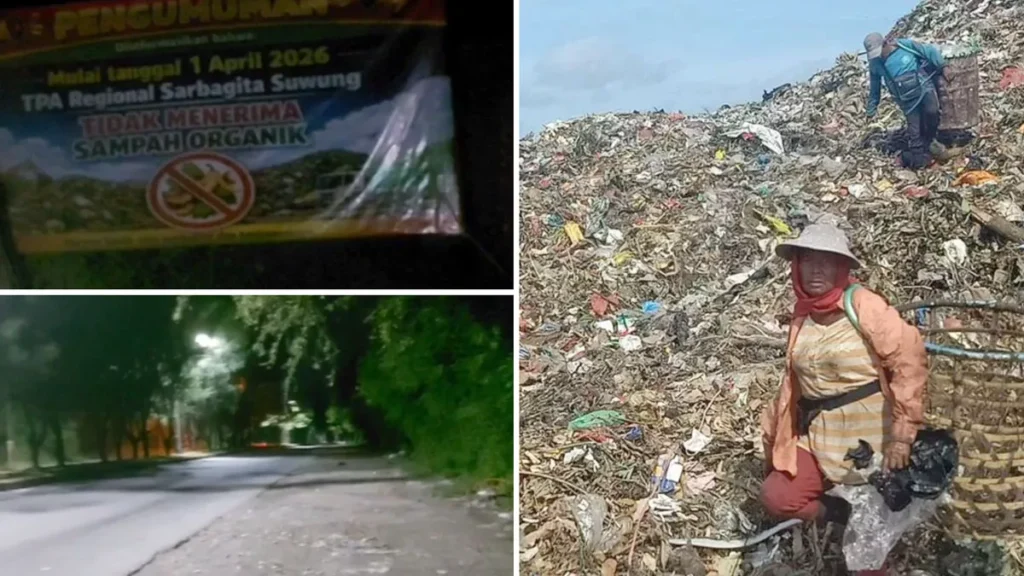
Collage Photo of Suwung Bali Landfill and the quiet activity at the Suwung entrance on April 1, 2026 at 00.00 WITA (Hey Bali)
The Bigger Picture: Why Suwung Is Closing
Governor Wayan Koster has been clear about the long-term goal. Suwung’s closure is not a punishment. It is a transformation.
The landfill has received waste from Denpasar, Badung, Gianyar, and Tabanan (the Sarbagita region) for years. But the model is unsustainable. Organic waste in landfills produces methane, a potent greenhouse gas. Leachate contaminates groundwater. And the mountain of trash grows taller every year.
The new policy is being implemented in phases:
| Date | Action |
| March 31, 2026 | Last day for organic waste acceptance |
| April 1, 2026 | Only inorganic and residual waste allowed |
| Until August 31, 2026 | Transition period before total closure |
| Early 2028 | Target operation date for new waste-to-energy plant |
The Solution: PSEL – Waste-to-Energy by 2028
Bali’s provincial government is betting on technology to solve what behavior change alone cannot.
A 6-hectare plot of land, owned by state port operator PT Pelindo, has been designated for a Pengolahan Sampah menjadi Energi Listrik (PSEL) facility—a waste-to-energy plant.
Key specifications:
- Capacity: 1,200 tons of waste per day
- Service area: Denpasar and Badung
- Operator: Zhejiang Weiming Environment Protection Co., Ltd. (China)
- Construction start: June 2026
- Completion target: End of 2027
- Operational target: Early 2028
If successful, the plant will process what Suwung can no longer accept. But that is nearly two years away. Until then, the burden falls entirely on drivers, waste collectors, and households to sort perfectly—or face the gate.
A Critical Look: Policy Without Preparation?
Let us be direct with our audience.
Bali’s decision to shut Suwung to organic waste is environmentally necessary. The old model was killing the landfill and poisoning the surrounding community. But necessity does not excuse poor execution.
Drivers like Ferdy are not villains. They are workers caught between a well-intentioned regulation and a physical reality: perfect sorting is difficult, time-consuming, and currently, the only path to disposal.
The government has provided no intermediate drop-off points for organic waste. No composting facilities operating at scale. No clear threshold for what constitutes “acceptable” contamination.
Instead, the message is simple: “Turn around and try again.”
That is not a solution. It is a bottleneck.
What This Means for Expats, Travelers, and Global Readers
To the expat living in a villa or banjar: Your waste collector may soon tell you that your trash is being rejected. If you want your garbage picked up, you must sort meticulously. Organic waste—food scraps, fruit peels, bones—cannot be mixed. Consider home composting or find a local organic waste service.
To the traveler: You may not see the queues at Suwung. But you will notice if waste collection in your area becomes sporadic. Respect local sorting guidelines in your accommodation. Do not assume “someone else will handle it.”
To the global reader: Bali is not alone in this struggle. Cities worldwide are grappling with landfill closures and the transition to circular waste systems. Watch how Bali handles the next two years. It may offer lessons—or warnings—for your own community.
A Final Observation
The officer at the gate, the exhausted agency head, the confused driver, the long queue under the tropical sun—this is not a failure of will. It is a failure of transition planning.
Bali knows where it wants to go. It has a waste-to-energy plant on the horizon. But between now and 2028, thousands of tons of waste will still be generated. And right now, the only answer for a truck with an orange peel is: “Turn around.”
That is not sustainable. And it is not fair to the people doing the dirty work of keeping Bali clean.
Hey Bali News will continue to follow this story as it develops. For expats, travelers, and global readers who want to understand the real Bali—beyond the beach photos—stay with us.