

































A group of Mexican musicians and dancers is helping keep one of Bali’s oldest artistic traditions alive, proving that culture can cross oceans without losing its soul.
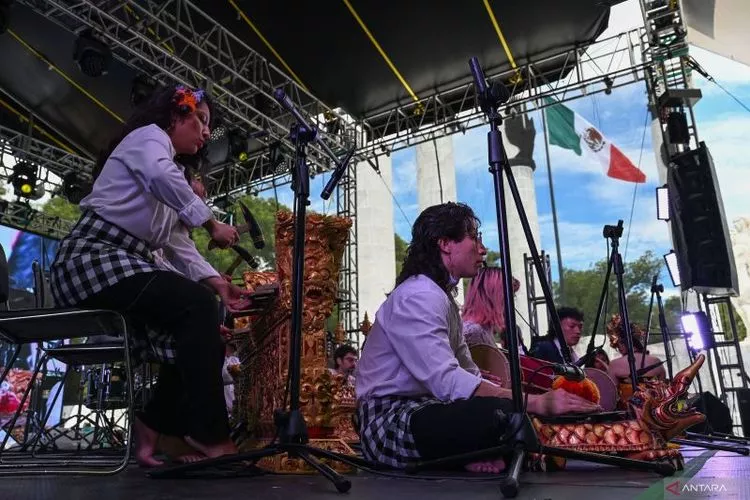
MEXICO CITY — Long before the first dancer stepped onto the stage, the unmistakable sound of Balinese gamelan echoed across Bosque de Chapultepec, one of Mexico City’s largest and most iconic public parks.
Within moments, applause began to ripple through the crowd.
Then came whistles, cheers, and finally a standing ovation.
But what surprised many spectators wasn’t the performance itself.
It was the people performing it.
The musicians striking the bronze gamelan instruments and the dancers moving gracefully across the stage were not from Bali.
They were Mexican.
The performance, presented by Gamelan Luz y Fuerza during Aldea Global 2026, transformed a public square thousands of miles from Indonesia into a celebration of Balinese culture, offering audiences a glimpse of an artistic tradition that has captivated people far beyond the island where it was born.
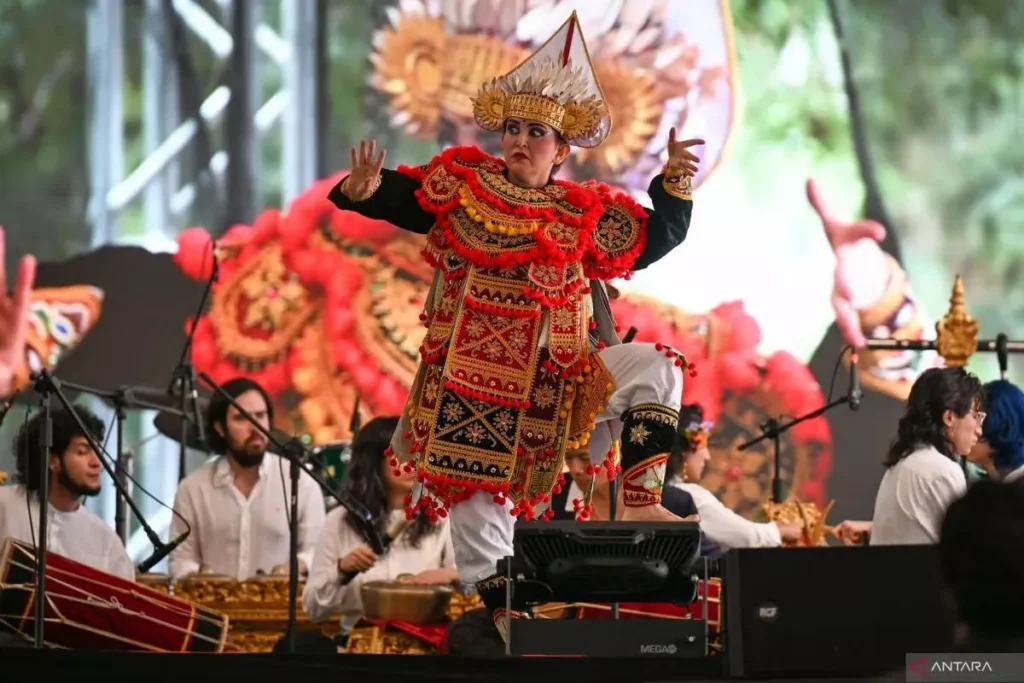
As the performance unfolded, audiences were taken on a journey through some of Bali’s best-known cultural expressions. Delicate movements from the Oleg Tamulilingan dance gave way to the powerful energy of the Baris warrior dance, before the familiar rhythmic chant of “cak… cak… cak…” recreated the atmosphere of Bali’s famous Kecak performance.
The audience didn’t remain spectators for long.
Toward the end of the show, performers invited people onto the stage to dance together to the rhythm of Balinese gamelan, accompanied by modern drum beats. Though many participants were experiencing Balinese dance for the very first time, they eagerly followed every movement, laughing, smiling and celebrating together.
When the performance ended, the applause continued.
Many rose to their feet.
For Nayeli, a resident of Mexico City, the experience was unlike anything she had seen before.
“Their music, dances and costumes felt almost like a spell,” she said. “I’ve never experienced anything like it.”
She thanked the Embassy of Indonesia in Mexico for introducing audiences to a tradition that had expanded her understanding of Indonesian culture.
Why Bali?
The success of the performance raises a fascinating question.
Why would a group of Mexican artists dedicate years of their lives to mastering one of Indonesia’s most distinctive cultural traditions?
For Ethan Zhihao Wang, founder of Gamelan Luz y Fuerza, the answer goes beyond music.
“I believe Balinese gamelan has the power to unite people and bring different communities together,” Wang said.
His belief has shaped the group’s mission.
Rather than simply reproducing Balinese performances, the ensemble seeks to build cultural bridges between Indonesia and Mexico.
To make Balinese music more approachable for local audiences, the group carefully blends traditional gamelan with modern percussion, introducing familiar rhythms while preserving the essence of the original compositions.
The approach appears to be working.
“I was honestly surprised by how much interest there is in Balinese culture here in Mexico,” Wang said.
His connection with Bali is deeply personal. He studied directly under Balinese artist I Nyoman Suadin, carrying knowledge from the Island of the Gods to Latin America.
Another member of the ensemble, Olinka Torres, has an equally remarkable story.
Her fascination with Balinese culture began two decades ago after watching a traditional performance.
“I fell in love with it the very first time I saw it,” she recalled.
That fascination eventually brought her to Bali, where she lived for an extended period while studying at the Indonesian Institute of the Arts (ISI) Bali.
Bali’s Cultural Influence Travels Far Beyond Tourism
For millions of travelers, Bali is synonymous with beaches, temples and spectacular sunsets.
Yet moments like these reveal another side of the island’s global influence.
Its culture doesn’t simply attract visitors.
It inspires people to become lifelong students of its traditions.
Indonesia’s Ambassador to Mexico, Toferry Primanda Soektikno, said enthusiasm for Indonesian arts continues to grow among Mexican audiences.
Although most members of Gamelan Luz y Fuerza are Mexican, he noted that the quality of their performances rivals many professional ensembles in Indonesia.
The cultural exchange is expected to continue when the group performs again at Mexico City’s historic Zócalo during the first week of July, introducing Balinese music and dance to even larger audiences.
In an era where cultural traditions often struggle to survive rapid modernization, the scene unfolding in Mexico offers a different narrative.
Thousands of miles from Bali, people who have no ancestral connection to the island are choosing to preserve, perform and celebrate its heritage.
Perhaps that is one of the greatest compliments a culture can receive.
Not that it is admired from afar.
But that it is loved enough for others to make it part of their own story.
Source: Antaranews