


































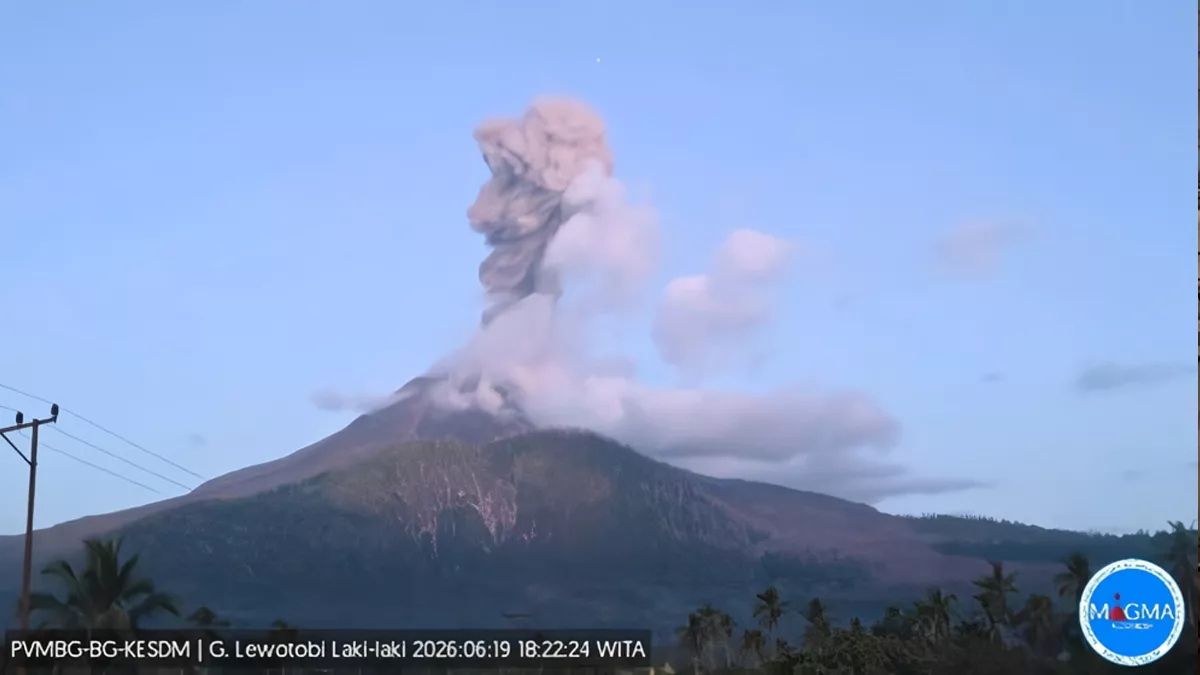
EAST FLORES – Indonesia’s Mount Lewotobi Laki-Laki erupted again on Sunday morning, sending a thick column of volcanic ash 1.4 kilometers above its summit as authorities renewed warnings for residents and travelers to stay away from the active volcano.
The eruption occurred at 7:04 a.m. local time on Flores Island in East Nusa Tenggara Province, according to Indonesia’s volcano monitoring agency.
The volcano remains at Alert Level III (Standby), the second-highest level in Indonesia’s four-tier volcanic alert system.
Ash Plume Drifted Toward the Northeast
Officials reported that the eruption produced a dense gray ash cloud rising approximately 1,400 meters above the summit, reaching an altitude of 2,984 meters above sea level.
The volcanic plume drifted toward the north and northeast, depending on prevailing winds.
According to Bramantya Aji Putra M, an officer at the Mount Lewotobi Laki-Laki Observation Post, the eruption lasted for about 74 seconds and was recorded on monitoring instruments with a maximum seismic amplitude of 47.3 millimeters.
The eruption is the latest in a series of volcanic activities that have kept the mountain under close observation by Indonesia’s geological authorities.
Visitors Told to Stay at Least Five Kilometers Away
Authorities have urged residents and tourists not to enter a five-kilometer (3.1-mile) exclusion zone around the volcano’s crater.
Officials also advised the public to remain calm, follow updates issued by the East Flores Regency Government, and avoid misinformation circulating on social media or unofficial sources.
Indonesia sits along the Pacific Ring of Fire, making volcanic activity a regular occurrence across the archipelago. The country is home to more active volcanoes than any other nation in the world.
Rain Could Trigger Dangerous Lahars
Volcanologists are also warning of the potential for lahars, fast-moving volcanic mudflows that can develop when heavy rainfall mixes with fresh volcanic ash and debris.
Communities near rivers originating from Mount Lewotobi Laki-Laki, particularly Dulipali, Padang Pasir, Nobo, Nurabelen, Klatanlo, Hokeng Jaya, Boru, and Nawakote, have been advised to remain alert during periods of intense rain.
Lahars can travel rapidly downstream, carrying rocks, ash, and volcanic material capable of damaging roads, bridges, farmland, and settlements.
Residents Advised to Wear Masks
Authorities also reminded residents living in areas affected by volcanic ashfall to wear face masks or other nose-and-mouth coverings to reduce the risk of respiratory irritation caused by fine volcanic particles.
Local officials continue to coordinate closely with the Mount Lewotobi Laki-Laki Observation Post and Indonesia’s Center for Volcanology and Geological Hazard Mitigation (PVMBG) to monitor the volcano’s activity and provide updated safety information.
No Immediate Impact on Bali
Mount Lewotobi Laki-Laki is located on Flores Island, approximately 500 kilometers (310 miles) east of Bali.
As of Sunday morning, there were no reports of disruptions to flights, tourism activities, or daily life in Bali resulting from the eruption.
However, travelers planning to visit Flores or fly through eastern Indonesia are advised to monitor airline announcements and official updates, as volcanic activity can change rapidly depending on wind direction and the intensity of future eruptions.