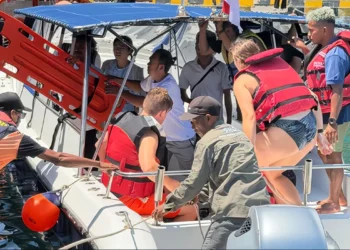


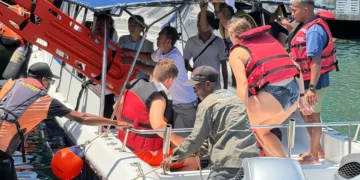





























The couple spent hours trapped on a narrow ledge at Padang-Padang Beach as rescuers waited for the tide to turn. Their ordeal highlights a recurring risk for visitors exploring Bali’s dramatic coastline.
PECATU, Bali – The sunset at Padang-Padang Beach was meant to be the highlight of an evening stroll.
Instead, it became the beginning of a seven-hour ordeal.
Two Russian tourists, Shumskikh Ariadna Anatolievna, 22, and Kristia Kirill Eduardovich, 23, were rescued in the early hours of Sunday after being trapped by rising tides on a steep cliff face at one of Bali’s most photographed beaches.
The couple had arrived at Padang-Padang around 5:00 PM on Saturday. They swam for approximately 30 minutes, then began walking along the shoreline as the sun began its descent.
What they did not anticipate was how quickly the Indian Ocean would rise.
“About 35 minutes after they started walking along the beach, suddenly the waves grew larger and crashed onto the shore, trapping both victims,” said Iptu I Gede Adi Saputra Jaya, Head of Public Relations at Denpasar Police, on Sunday.
A Desperate Call for Help
As darkness fell and the water rose, the couple attempted to climb the cliff to safety.
But the rock face proved too steep.
Too sharp.
Too high.
With nowhere to go and the tide still rising, Shumskikh did what any traveler in distress would do: she reached for her phone.
Using the Telegram messaging app, she contacted a friend, Ruslan Gruzinskii, who then alerted Wedy Salmanto. The message was passed to Indonesia’s search and rescue agency, Basarnas.
The report came in at approximately 9:30 PM.
By 10:05 PM, seven rescue personnel were on their way.
Waiting for the Sea to Retreat
Finding the couple took about an hour.
They were located on a narrow ledge — trapped between a cliff they could not climb and a sea they could not enter.
But finding them was only half the challenge.
The cliff was steep and sharp. Darkness made navigation dangerous. And the tide was still high.
Rescuers checked the tide charts. According to data from Indonesia’s meteorology agency (BMKG), the water was not expected to recede until approximately 3:00 AM.
So they waited.
For hours, the two Russian tourists remained on the ledge, monitored by rescue teams who could not yet reach them. The sea churned below. The cliff rose above. And time moved slowly.
The Rescue
Just after 2:00 AM, conditions finally shifted.
Using high-angle rope rescue techniques, a single rescue team member was lowered down the cliff face. One by one, the two tourists were brought up to safety.
“Considering the safety of the team and the safety of the victims, we successfully evacuated them around 2:00 AM,” said Wahyu, the field coordinator for the Denpasar Search and Rescue Office.
Both were alive.
Both were conscious.
Shumskikh emerged without physical injury. Kristia suffered abrasions on both knees and his left palm.
When rescuers suggested a hospital visit for medical evaluation, the couple declined.
“They felt healthy and had no serious injuries,” the police spokesperson explained. “They asked to return to their villa.”
A Familiar Risk
Padang-Padang Beach is not unknown to international visitors.
Located in the Pecatu village on Bali’s southern Bukit Peninsula, the beach is famous for its cave entrance, white sand, and powerful surf. It has appeared in Hollywood films. It is photographed thousands of times each day.
But it is also dangerous.
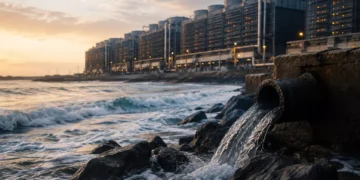
The same dramatic coastline that draws travelers also conceals risks: rapidly rising tides, steep cliffs that become impassable, and waves that can shift from gentle to deadly in minutes.
This is not the first time tourists have been trapped in this area.
It will almost certainly not be the last.
What This Means for Travelers
For international visitors planning trips to Bali, the incident offers several practical reminders.
First, tide awareness matters. The difference between low tide and high tide at Padang-Padang can be several meters. Checking local tide charts before walking along the shoreline is not optional — it is essential.
Second, daylight is a resource. The couple began their swim at 5:00 PM. By 6:00 PM, sunset was approaching. By 7:00 PM, darkness made navigation exponentially more difficult. Starting late afternoon activities along exposed coastlines leaves little margin for error.
Third, communication saved lives. Shumskikh had phone reception and a messaging app. She reached a friend. The friend reached rescuers. Without that chain of communication, the outcome could have been very different.
Fourth, rescue capacity exists — but it takes time. The operation lasted more than seven hours. Teams coordinated across multiple agencies: Basarnas, water police (Satpolairud), lifeguards (Balawista), and local residents. The system worked. But it was not fast.
A Broader Question
For Bali’s tourism industry, incidents like this raise a recurring question.
As visitor numbers grow and travelers venture further into the island’s more remote corners, is the infrastructure for prevention keeping pace with the infrastructure for rescue?
Warning signs exist at some beaches. But not all. Tide charts are available online. But not every tourist checks them. Local knowledge is abundant. But language barriers can prevent it from reaching those who need it most.
The successful evacuation of two Russian tourists from Padang-Padang is a testament to Indonesia’s search and rescue capabilities.
But the fact that they needed rescuing at all suggests that prevention — through better signage, clearer warnings, and more accessible information — may still have room to improve.
After the Ordeal
By dawn on Sunday, the two Russian tourists were back at their villa.
They declined medical attention.
They declined hospital transport.
They simply wanted to leave.
For the rescue teams who spent the night on the cliff, the operation was another success — another life saved, another crisis averted.
For the two young travelers, it was likely a night they will not soon forget.
And for the rest of us watching from a distance, it was a reminder that even paradise has its dangers — and that the ocean, beautiful as it may be, does not negotiate.