


































BALI, Indonesia — Southeast Asia has reestablished itself as one of the world’s most competitive tourism regions.
The numbers for 2025 are becoming clearer.
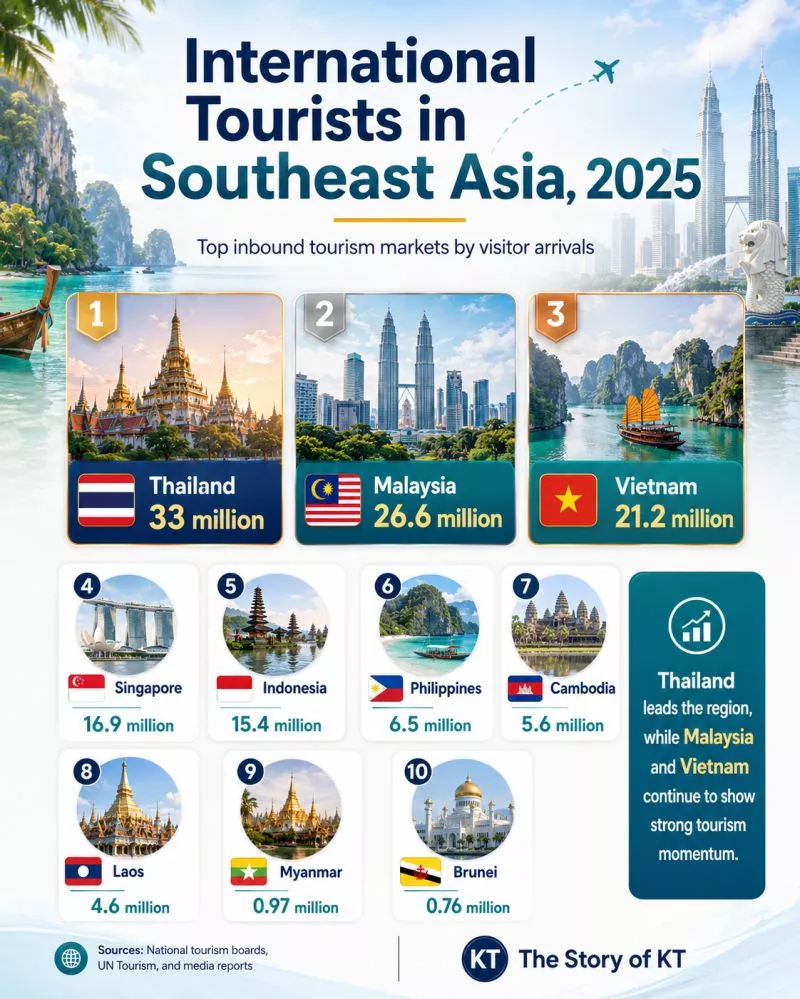
Thailand welcomed approximately 33 million international visitors.
Malaysia recorded 26.6 million.
Vietnam reached 21.2 million.
Singapore attracted 16.9 million.
Indonesia finished with 15.4 million.
At first glance, the ranking looks uncomfortable.
Indonesia, a country of more than 17,000 islands with destinations ranging from Bali and Labuan Bajo to Raja Ampat and Komodo, attracted fewer international visitors than Singapore, a city-state smaller than Bali itself.
The question is not whether 15.4 million visitors is good.
It is.
The question is why Indonesia continues to underperform relative to its potential.
The Regional Scoreboard
| Country | International Arrivals (2025) |
|---|---|
| Thailand | 33 million |
| Malaysia | 26.6 million |
| Vietnam | 21.2 million |
| Singapore | 16.9 million |
| Indonesia | 15.4 million |
| Philippines | 6.5 million |
| Cambodia | 5.6 million |
| Laos | 4.6 million |
| Myanmar | 0.97 million |
| Brunei | 0.76 million |
The ranking itself does not tell the full story.
Singapore benefits from functioning as a major aviation hub.
Malaysia benefits from substantial cross-border traffic.
Thailand benefits from decades of tourism infrastructure development.
But those explanations only answer part of the question.
Indonesia still has not closed the gap.
Vietnam Is The Story Nobody Can Ignore
Perhaps the most important number is not Thailand’s 33 million.
It is Vietnam’s 21.2 million.
Just a few years ago, Vietnam was not widely discussed as Southeast Asia’s fastest rising tourism competitor.
Today, it increasingly is.
Giostanovlatto, a tourism observer, argues that Vietnam’s rise is less about geography and more about execution.
“Vietnam is not winning because it suddenly discovered beaches or mountains,” he said.
“They improved accessibility, simplified entry requirements, expanded connectivity, and marketed aggressively. Tourism growth rarely happens accidentally.”
He argues Indonesia should be less concerned about who currently leads and more concerned about who is catching up quickly.
“Thailand leading is not surprising. Vietnam growing this quickly should get attention.”
Indonesia’s Bali Problem
Indonesia’s tourism economy has become heavily concentrated.
Bali remains the country’s strongest tourism product.
Possibly too strong.
Giostanovlatto argues that this concentration creates a structural weakness.
“For years Bali compensated for weaknesses elsewhere,” he said.
“But Bali cannot function as the tourism strategy for an entire country.”
Outside Bali, tourism infrastructure becomes less predictable.
Flight connectivity weakens.
Travel times increase.
Costs rise.
A visitor moving between Bali, Labuan Bajo, Raja Ampat, and North Sulawesi quickly discovers that Indonesia is not one tourism destination.
It is many destinations stitched together.
Connectivity Matters More Than Natural Beauty
Tourists rarely choose destinations using geography alone.
They choose convenience.
Thailand built extensive aviation networks.
Singapore built itself into a transit machine.
Vietnam expanded aggressively.
Indonesia possesses extraordinary natural advantages.
But natural advantages do not automatically become visitor arrivals.
Giostanovlatto believes this is where many discussions about tourism become misleading.
“People often ask why Singapore beats Indonesia despite having fewer natural attractions,” he said.
“That question assumes tourists prioritize scenery first. Often they prioritize convenience.”
The Hard Question
Fifteen million visitors is not failure.
Many countries would celebrate those numbers.
But tourism competition rarely works through absolute numbers.
It works through momentum.
Thailand remains dominant.
Vietnam continues climbing.
Malaysia remains consistent.
Indonesia continues debating potential.
Potential itself is not a tourism strategy.
And perhaps that is the uncomfortable part of the ranking.
The region is no longer competing on who has the best beaches.
It is increasingly competing on who makes travel easiest.
For now, the numbers suggest Indonesia still has work to do.