

































BADUNG, Bali — When airspace over parts of the Middle East began to close in late February, the shock did not stay confined to the region.
It traveled—quietly but swiftly—across continents, into flight paths, airport terminals, and eventually to an island thousands of kilometers away.
In Bali, the impact was immediate.
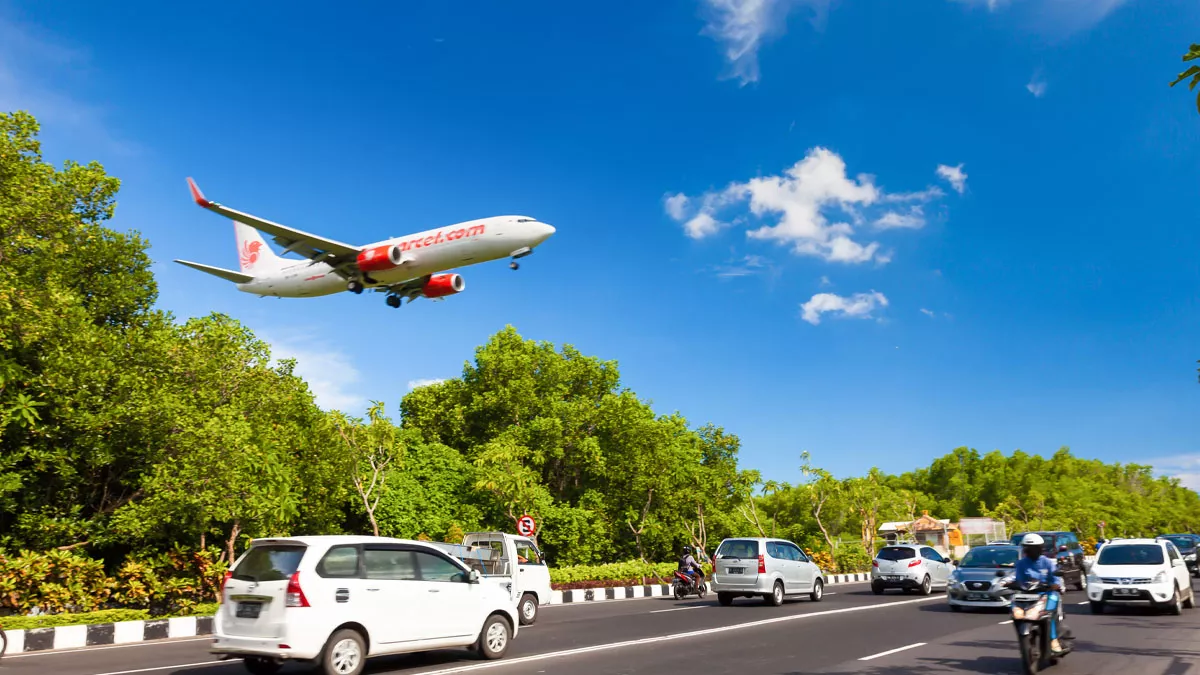
Within days of escalating tensions between the United States, Israel, and Iran, 64 international flights were canceled at Ngurah Rai International Airport. More than 8,000 passengers were left stranded or forced to reroute. Key transit hubs—Doha, Dubai, Abu Dhabi—suddenly became unreliable links in a system Bali depends on but does not control.
For an economy built on movement, the disruption was not abstract. It was measurable.
Officials estimate that foreign arrivals fell by roughly 800 visitors per day during the peak of the disruption.
The skies have since reopened—partially, cautiously. But the illusion that Bali is insulated from global shocks has quietly disappeared.
A Tourism Economy at the Mercy of Geography
Bali’s vulnerability is structural.
Unlike major global hubs, the island does not sit at the center of air traffic networks. It depends on them. Long-haul visitors—particularly from Europe and the United States—rely heavily on transit routes through the Middle East.
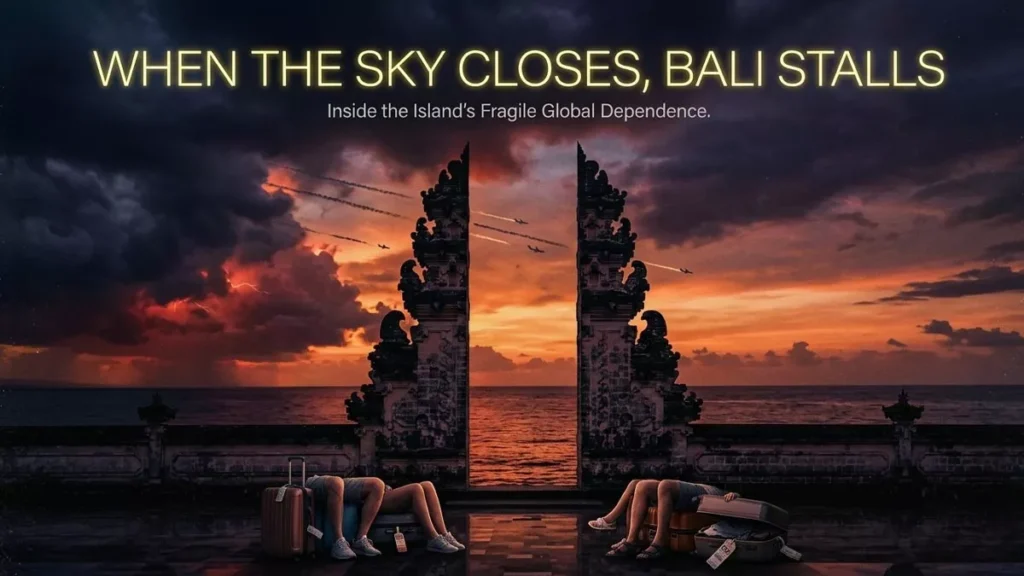
When those routes are disrupted, Bali does not slow down. It stalls.
This is the paradox of global tourism: the more connected a destination becomes, the more exposed it is to forces far beyond its borders.
The Strategic Pivot: Looking East
In response, Bali is doing what many economies do in times of uncertainty—diversifying.
The shift is already visible.
India and China have emerged as two of Bali’s largest inbound markets, with more than 569,000 and 537,000 visitors respectively in 2025. Growth from South Korea and Japan has been equally notable, with double-digit increases year-on-year.
These markets offer something critical: proximity.
Travelers from East Asia can reach Bali without relying on Middle Eastern airspace, often through direct flights or regional hubs like Singapore, Thailand, or Taiwan. In a world of unstable routes, geography becomes strategy.
But diversification is not simply about shifting numbers. It is about reducing risk.

Australia: The Anchor Market
Even as Bali looks east, its most reliable foundation remains to the south.
Australia continues to dominate arrivals, contributing more than 1.6 million visitors in 2025 alone.
The reasons are straightforward: short flight times, frequent connections, and decades of travel familiarity.
In moments of global disruption, this market does something others cannot—it holds.
For Bali, Australia is not just a top source of visitors. It is a stabilizer.
Beyond Volume: Rethinking What Bali Sells
But markets alone are not enough.
What Bali offers is changing, too.
The island is gradually shifting from volume-driven tourism to value-driven experiences—cultural immersion, village tourism, and specialized segments such as sports and wellness travel.
The change is subtle but strategic.
Higher-value travelers tend to be less sensitive to price shocks, more flexible in planning, and less dependent on rigid travel routes. In an unstable world, they represent resilience.
At the same time, digital platforms are reshaping how Bali markets itself. Millennials and Gen Z travelers—accustomed to booking, paying, and discovering destinations online—are becoming central to that shift.
Even the cruise industry is gaining ground. In 2025, 65 cruise ships brought approximately 140,000 international visitors to Benoa Port—a figure expected to rise further in 2026.
Unlike air travel, cruise routes operate within a different logistical framework—one less exposed to airspace disruptions.

The Hidden Variable: Energy
The deeper vulnerability, however, lies beneath the surface.
Roughly 20 percent of global oil trade passes through the Strait of Hormuz. When tensions rise in the Middle East, the impact is felt not just in geopolitics, but in fuel prices.
And fuel prices shape everything.
Airfares rise. Operating costs increase. Travel demand softens.
Oil briefly surged past $100 per barrel following the escalation—well above Indonesia’s budget assumptions.
The government has moved to cushion the blow, offering transport subsidies and fare discounts to sustain domestic mobility. But such measures buy time—they do not remove the underlying exposure.
A Lesson Bali Has Learned Before
This is not Bali’s first crisis.
During the pandemic, the island’s tourism economy collapsed almost entirely. Recovery came, in part, from domestic travelers—reminding policymakers that resilience often begins at home.
That lesson is shaping current thinking.
Efforts to strengthen sectors beyond tourism—particularly agriculture—reflect a broader recognition: an economy built on a single pillar is inherently fragile.
The Real Question
The Middle East conflict will eventually subside. Airspace will stabilize. Routes will normalize.
But the underlying question will remain.
How does an island economy, dependent on global flows it cannot control, build resilience in a world defined by disruption?
Bali’s answer, for now, is pragmatic: diversify markets, deepen regional connectivity, upgrade its tourism offering, and invest in systems that reduce dependence on any single route or region.
It is not a perfect solution.
But it is an acknowledgment of a new reality.
After the Disruption
The skies over Bali are open again.
Flights have resumed. Tourists are returning. The system, outwardly, appears intact.
But something fundamental has shifted.
Distance no longer guarantees safety. Geography no longer provides insulation. And for Bali, an island that thrives on global movement, stability is no longer a given.
It is something that must be built—route by route, market by market, crisis by crisis.
By Giostanovlatto, Founder of Hey Bali, Bali-based journalist