


































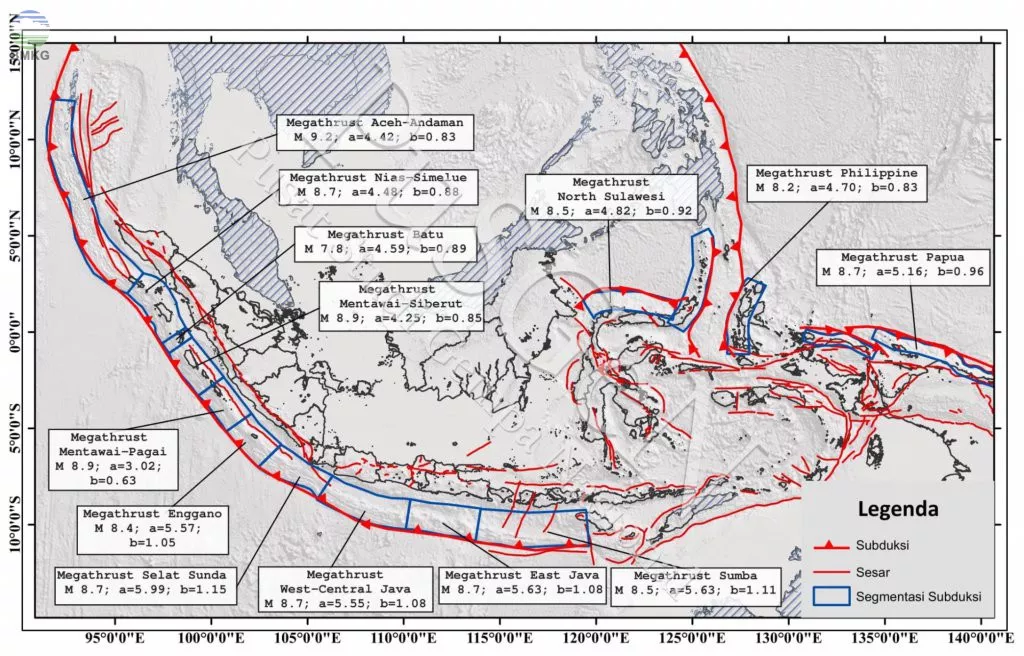
A new national earthquake hazard assessment reveals an increased threat level across the archipelago, with the Java megathrust zone holding a potential for a magnitude 9.1 event, underscoring the perpetual need for preparedness.
JAKARTA, Indonesia — Situated on the volatile Pacific Ring of Fire, Indonesia faces a constant geological threat. The nation’s vulnerability has been formally reassessed in the 2024 Indonesian Earthquake Source and Hazard Map, which now identifies 14 distinct megathrust zones, an increase from the 13 zones cataloged in the previous 2017 map. This update signals a heightened understanding of the seismic risks looming over the archipelago.
According to Professor Iswandi Imran, a member of the Indonesian Academy of Sciences (AIPI) and a geophysics expert from the Bandung Institute of Technology (ITB), the updated map indicates a tangible escalation in hazard levels for specific regions. “When comparing the 2017 map with the 2024 version, the contour lines are denser in 2024, indicating an actual increase in earthquake hazard in certain areas of Indonesia,” Imran explained during a recent briefing.
The Critical Zones and Their Maximum Potential
The map details zones capable of generating some of the most powerful earthquakes on Earth. Of particular note is the Java Megathrust Zone, which holds a potential maximum magnitude of 9.1. Other high-potential zones include Enggano and the Mentawai-Pagai zones, each with a maximum potential of 8.9.
The 14 zones, as listed in the 2024 map, are:
- Aceh-Andaman (M9.2)
- Nias-Simelue (M8.7)
- Batu (M7.8)
- Mentawai-Siberut (M8.9)
- Mentawai-Pagai (M8.9)
- Enggano (M8.9)
- Java (M9.1)
- Western Java (M8.9)
- Eastern Java (M8.9)
- Sumba (M8.9)
- North Sulawesi (M8.5)
- Cotobato Trench (M8.3)
- Southern Philippines (M8.2)
- Central Philippines (M8.1)
A Warning of Impending Activity
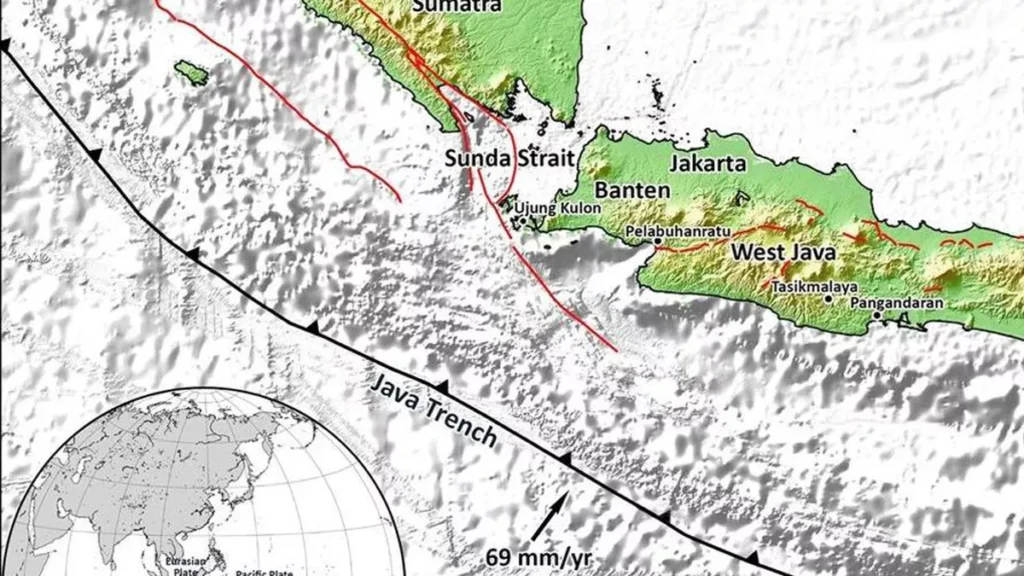
The scientific warning extends beyond mapping. Daryono, Head of the Earthquake and Tsunami Center at Indonesia’s Meteorology, Climatology, and Geophysics Agency (BMKG), has highlighted specific zones that are critically “overdue” for a major seismic event due to a long period of inactivity, known as a seismic gap. He specifically pointed to the Sunda Strait Megathrust and the Mentawai-Siberut Megathrust as areas where a significant earthquake is “only a matter of time.” A magnitude 5.2 quake that struck West Nias in early May 2025 was directly attributed to activity within the Mentawai-Siberut zone.
Context and Preparedness for the Bali Community
For residents, expatriates, and the millions of visitors in Bali, this scientific update is a sobering reminder of the natural forces that shape the Indonesian landscape. While Bali itself is not highlighted as a primary megathrust zone on this list, its proximity to the highly active Java and Sunda Strait zones means it remains within a region of significant seismic risk. Earthquakes centered in these adjacent zones can be strongly felt across the island and carry a associated tsunami threat.
This information is not intended to incite fear, but to reinforce the critical importance of preparedness. Understanding the risk landscape is the first step. Authorities and communities must continue to prioritize robust early warning systems, clear evacuation protocols, earthquake-resistant construction standards, and ongoing public education campaigns.
Living in and visiting Indonesia’s beautiful islands requires an awareness of their dynamic geology. This updated hazard map serves as a crucial tool for building a more resilient future.
Hey Bali News provides factual reporting on regional environmental risks to support an informed and prepared community.
#heybalinews