


































BALI, Indonesia — For many travelers in Bali, an eruption on a remote volcano hundreds of kilometers away may seem like somebody else’s problem.
History suggests otherwise.
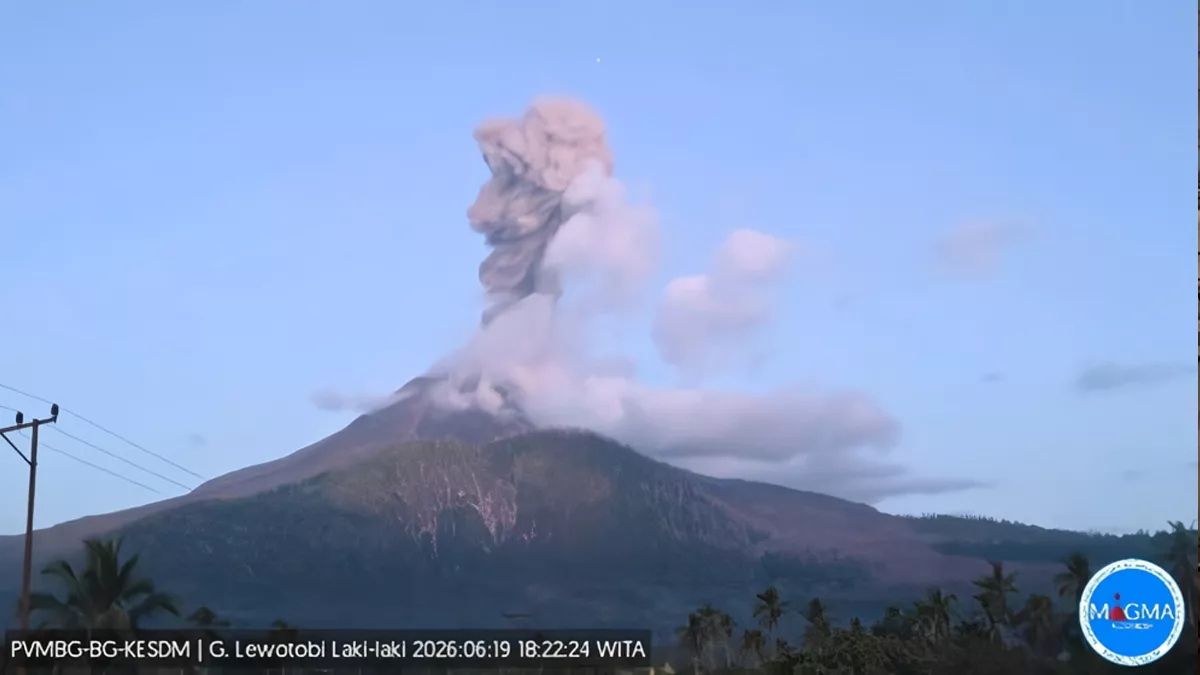
Mount Lewotobi Laki-Laki, an active volcano in East Flores, East Nusa Tenggara, erupted again on Friday evening at 6:22 PM local time, sending a thick column of volcanic ash approximately one kilometer above its summit and prompting renewed warnings from Indonesian authorities.
While no flight disruptions have been announced so far, the eruption serves as a reminder that volcanic activity in eastern Indonesia has repeatedly affected air travel across some of the country’s most important tourism destinations—including Bali and Labuan Bajo.
According to Indonesia’s Center for Volcanology and Geological Hazard Mitigation, the volcano produced a dense grey ash plume drifting toward the west and northwest. The eruption lasted approximately one minute and nineteen seconds and was recorded with a maximum seismic amplitude of 47.3 millimeters.
Authorities continue to maintain Mount Lewotobi Laki-Laki at Level III (Alert/Siaga) and have warned residents and visitors to stay at least five kilometers away from the crater.
“We urge the public and tourists not to conduct any activities within a five-kilometer radius of the eruption center,” volcano monitoring officer Bramantyo Aji Putra Mahendra said in an official statement.
The warning may sound routine. Yet for frequent visitors to Bali, the volcano’s recent history tells a more consequential story.
Just one year ago, a series of powerful eruptions from the same volcano caused significant disruption to aviation across eastern Indonesia. Flights connecting Bali, Labuan Bajo, Australia, Singapore, South Korea, and several domestic destinations were delayed or canceled as volcanic ash drifted into critical air corridors. At one point, dozens of flights at Bali’s Ngurah Rai International Airport were canceled, while services to and from Labuan Bajo faced repeated interruptions.
During a major eruption in June 2025, volcanic ash from Lewotobi disrupted 87 flights in a single day, affecting both international and domestic routes, including connections between Bali and Labuan Bajo.
Earlier eruptions also forced airlines including Jetstar, Virgin Australia, AirAsia, Singapore Airlines, and other regional carriers to suspend or reschedule services to Bali due to aviation safety concerns associated with volcanic ash clouds.
For travelers planning trips between Bali and Flores, particularly those heading to Komodo National Park through Labuan Bajo, the latest eruption is not necessarily a reason to cancel travel plans. However, it is a reason to stay informed.
Volcanic ash poses one of the most serious hazards to aircraft operations. Unlike ordinary weather systems, ash clouds can damage jet engines, reduce visibility, and create dangerous flight conditions even hundreds of kilometers from the eruption site. As a result, airlines often cancel flights preemptively whenever ash dispersion models indicate potential risk.
Travel experts recommend that visitors with upcoming flights to Bali, Labuan Bajo, or eastern Indonesia monitor airline notifications closely, maintain flexible itineraries where possible, and consider travel insurance that covers volcanic disruptions.
Authorities are also warning communities surrounding the volcano to remain vigilant for potential rain-triggered lahars, or volcanic mudflows, particularly in river systems flowing through Dulipali, Padang Pasir, Nobo, Nurabelen, Klatanlo, Hokeng Jaya, Boru, and Nawakote.
Residents affected by ashfall have been advised to wear masks and other protective coverings to reduce respiratory exposure.
For now, Bali’s airports remain fully operational, and there are no official reports of flight cancellations linked to Friday’s eruption.
But in a region shaped by volcanoes, today’s ash plume is a reminder of how quickly conditions can change.
For visitors enjoying sunsets in Seminyak, diving in Nusa Penida, or preparing for a Komodo adventure in Labuan Bajo, keeping one eye on the volcanoes has become part of traveling through Indonesia.