



































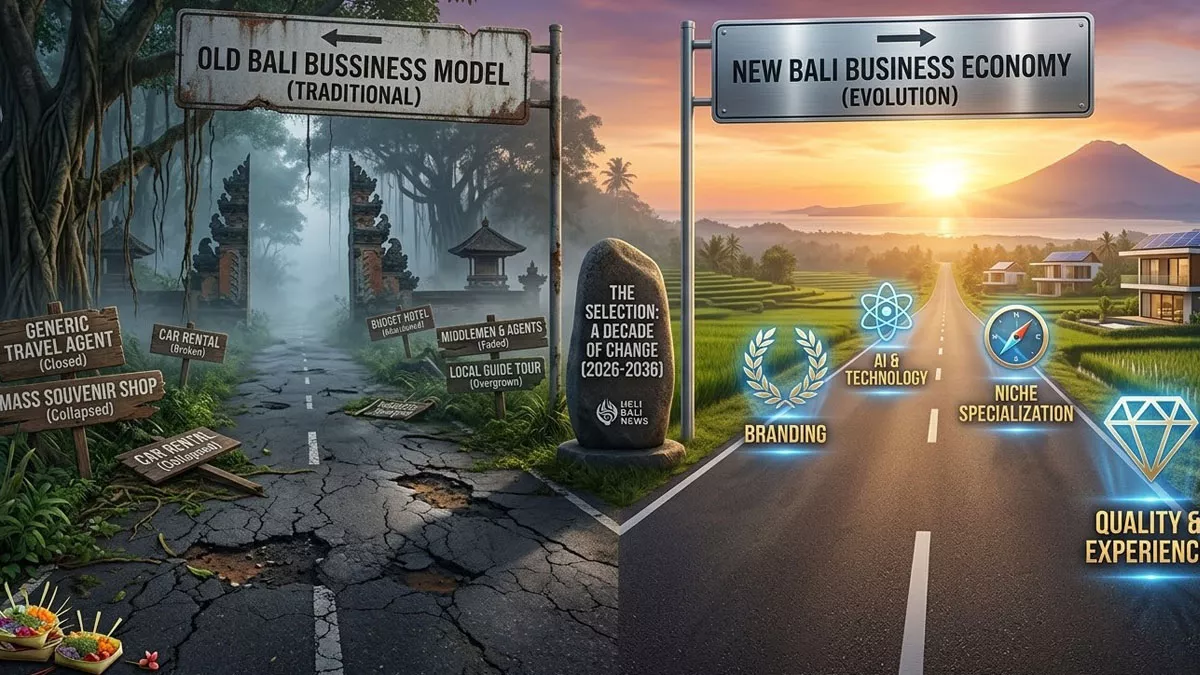
BADUNG, Bali — For years, Bali has sold a simple promise: build it, and tourists will come.
A villa in Canggu. A café with good coffee. A small travel agency with standard tour packages. For a long time, that formula worked.
It may not work anymore.
Across the island, subtle but unmistakable shifts are underway. Occupancy rates fluctuate more sharply. Competition has intensified. Travelers are more selective, more digital, and far less dependent on traditional intermediaries.
What we are witnessing is not a collapse—but a transition. Bali’s tourism economy is moving from easy growth to a more competitive, more sophisticated phase.
And in that transition, some business models will struggle to survive.
1. Small Travel Agents Without a Niche
Risk Level: High
The era of the generic travel agent is ending.
Today’s travelers don’t need someone to book hotels or arrange airport transfers. Platforms like Booking.com, Airbnb, and Expedia have replaced that function entirely.
What remains is specialization.
Travel agents who offer nothing beyond standard packages are already losing relevance. The survivors will be those who design experiences—luxury itineraries, retreats, or complex multi-day adventures that require human expertise.
Reality: This is not a slow decline. It is already happening.
2. Budget Hotels Without Identity
Risk Level: High
In areas like Kuta and Legian, the problem is no longer demand—it’s oversupply.
Too many rooms. Too little differentiation.
Travelers are no longer choosing the cheapest option. They are choosing:
- design
- experience
- uniqueness
A generic budget hotel is now competing not just with other hotels, but with villas, Airbnb stays, and boutique concepts.
What’s happening quietly:
Some of these hotels are already being repurposed—or simply fading out.
3. Car Rentals Without Digital Systems
Risk Level: Moderate–High
Bali still runs on drivers. That won’t disappear overnight.
But the way people book transport is changing fast.
Tourists increasingly prefer:
- fixed pricing
- online booking
- verified reviews
Platforms are slowly absorbing fragmented operators.
What changes:
Not the demand—but who controls it.
4. Mass Souvenir Shops (Old Tour Bus Model)
Risk Level: High
The old model was simple:
tour bus → stop → buy souvenirs.
That model is fading.
Today’s travelers:
- avoid “tourist traps”
- prefer artisan products
- shop online or directly from creators
Large, generic souvenir centers are losing relevance in a market that now values authenticity.
5. “Copy-Paste” Investment Villas
Risk Level: Moderate–High
This is the most sensitive topic—and the most misunderstood.
Bali is not running out of tourists.
But it may be running out of demand for average villas.
In areas like Canggu and Pererenan:
- supply has surged
- pricing pressure is increasing
- occupancy is uneven
Not all villas are at risk.
But the “build and hope” model is.
What survives:
- strong branding
- unique concepts
- professional management
What struggles:
everything else.
6. Generic Tour Activities
Risk Level: Moderate–High
ATV rides. Standard rafting. Basic sightseeing.
These still exist—but they are no longer enough.
Travelers now choose based on:
- reviews
- uniqueness
- storytelling
- visual experience
Average experiences are filtered out—literally—by algorithms.
7. Restaurants Without Identity
Risk Level: Moderate–High
Bali has more cafés and restaurants than ever.
But more options don’t mean more success.
The winners today are clear:
- concept-driven dining
- strong branding
- memorable atmosphere
The losers are equally clear:
- menus without identity
- spaces without character
This is no longer a market where “just opening a café” works.
8. Businesses That Only Act as Middlemen
Risk Level: High
This is where AI hits hardest.
Tasks being replaced:
- itinerary planning
- booking coordination
- customer service
- pricing
Platforms and AI systems now do these faster—and often better.
If a business exists only to connect buyers and sellers without adding value, it is already under pressure.
So What Actually Survives?
This is not a story about collapse.
It’s about selection.
Bali’s market is evolving toward:
- experience over convenience
- branding over volume
- quality over quantity
- systems over manual operations
The island is not losing demand.
It is raising the standard.
The Real Shift: Bali Is Growing Up
For years, Bali rewarded:
- speed
- replication
- low barriers to entry
That era is ending.
What replaces it is a more mature market—one that rewards:
- differentiation
- professionalism
- long-term thinking
Final Thought
The next decade in Bali won’t be defined by how many businesses open.
It will be defined by which ones remain relevant.
For investors, the takeaway is simple:
– If your business looks like ten others, it is already at risk.
– If your value can be replaced by an app, it eventually will be.
Bali is still one of the most attractive markets in Asia.
But it is no longer an easy one.