


































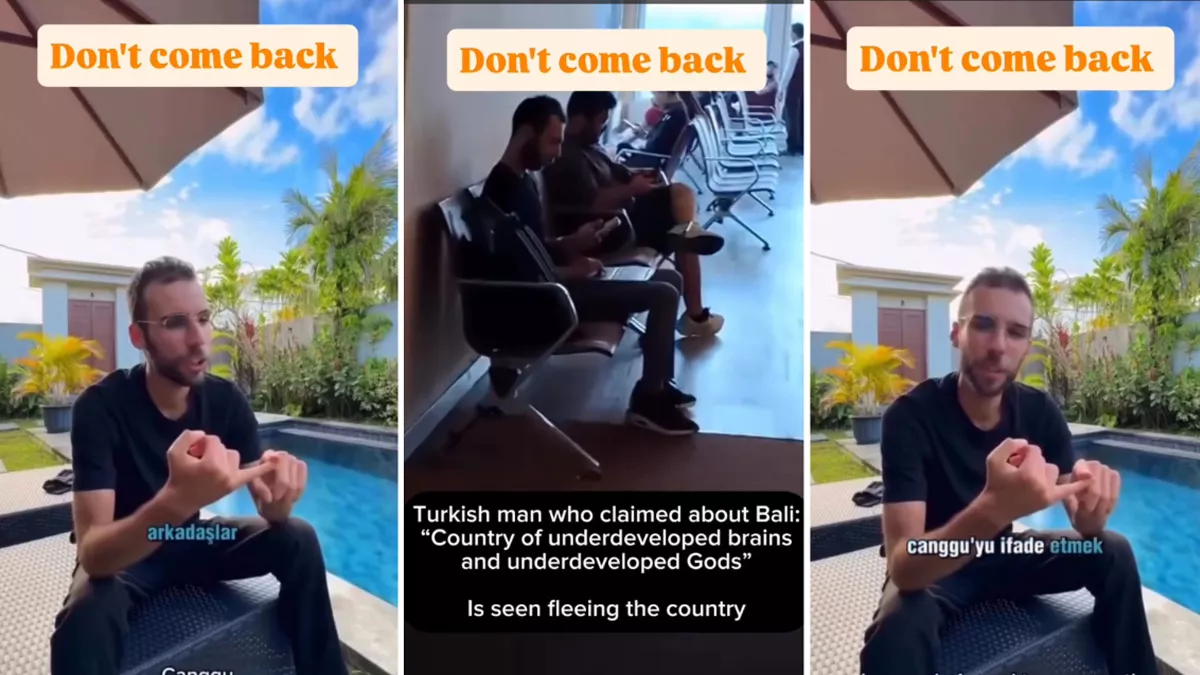
BADUNG, Bali — A short video recorded on a busy street in Canggu has reignited a familiar question in Bali’s tourism landscape: where is the line between free expression and respect for local culture?
In the footage, widely circulated over the weekend, a Turkish national delivers a series of remarks criticizing Bali and its people, including comments that many viewers interpreted as insulting to Balinese culture and religious traditions.
The video spread quickly across Indonesian social media, drawing strong reactions from local communities. Within days, the individual was no longer in Indonesia following action by immigration authorities.
A Video That Triggered a Swift Reaction
The recording appears to capture an unscripted moment, with the tourist speaking candidly about his impressions of Bali. His comments included disparaging references to local residents and dismissive remarks about cultural and religious practices.
For many viewers, the issue was not simply criticism—but tone.
The reaction online was immediate. Social media users, particularly from Bali, condemned the remarks as disrespectful, with many calling for authorities to take action.
Immigration Response
Indonesian immigration authorities confirmed that the individual had left the country after his conduct was reviewed under provisions governing the behavior of foreign nationals.
Under Indonesian law, visitors can face administrative action—including deportation—if their activities are deemed to disrupt public order or show disrespect toward local customs and values.
Authorities did not release detailed findings, but indicated that the case fell within the scope of those provisions.
A Familiar Pattern
While the incident drew significant attention, it is not entirely without precedent.
In recent years, Bali has seen several high-profile cases involving foreign visitors accused of inappropriate or disrespectful behavior—ranging from violations at sacred sites to controversial social media content.
Each case tends to follow a similar trajectory: public backlash, official review, and, in some instances, immigration action.
What distinguishes this episode is the directness of the remarks, which many observers saw as crossing from criticism into insult.
Balancing Openness and Boundaries
Bali’s global appeal has long been built on openness. The island welcomes millions of visitors each year, offering a blend of natural beauty, cultural depth, and relative accessibility.
But that openness operates within boundaries.
Giostanovlatto, a Bali-based tourism observer, said the incident reflects a broader tension between openness and cultural expectations.
“Bali has always been open to the world,” he said. “But openness does not mean the absence of expectations. Visitors are part of a shared space, and that comes with a basic responsibility to respect it.”
For local communities, cultural and religious practices are not symbolic—they are lived traditions. Public expressions that are perceived as dismissive or insulting can therefore carry weight beyond individual opinion.
For visitors, this creates a context that may differ from norms in their home countries, particularly in how speech and behavior are interpreted.
What This Means for Travelers
The incident highlights a broader reality for international visitors: expectations around conduct do not disappear in informal settings.
In Bali, as in many destinations with strong cultural identities, respect for local norms is not only social—it can also have legal implications.
Expressions that might be considered acceptable elsewhere may be viewed differently when they intersect with religion, identity, or community values.
A Question That Remains
The video has faded from the top of social media feeds, and the individual involved is no longer in the country. But the questions it raised remain relevant.
How should destinations balance openness with the need to protect cultural dignity? And where should the boundaries of acceptable expression be drawn in a place that depends on global tourism?
There are no simple answers.
But the episode underscores one point with clarity: in Bali, openness and respect are not opposing ideas—they are expected to exist together.