



































DENPASAR, Indonesia — Days after the arrest of one of Europe’s most wanted fugitives at Bali’s main international gateway, Indonesian authorities are now searching for two men believed to have traveled with him—raising new concerns about the broader presence of transnational criminal networks on the island.
Police say Steven Lyons, a British national and alleged leader of a major organized crime syndicate, did not arrive in Bali alone.
According to officials from Indonesia’s National Central Bureau (NCB) of Interpol, Lyons was accompanied by two associates—identified as Stephen Larwood and Lewis Wang—when he entered the country.
Both men are now being actively sought.
A Denial, and a Contradiction
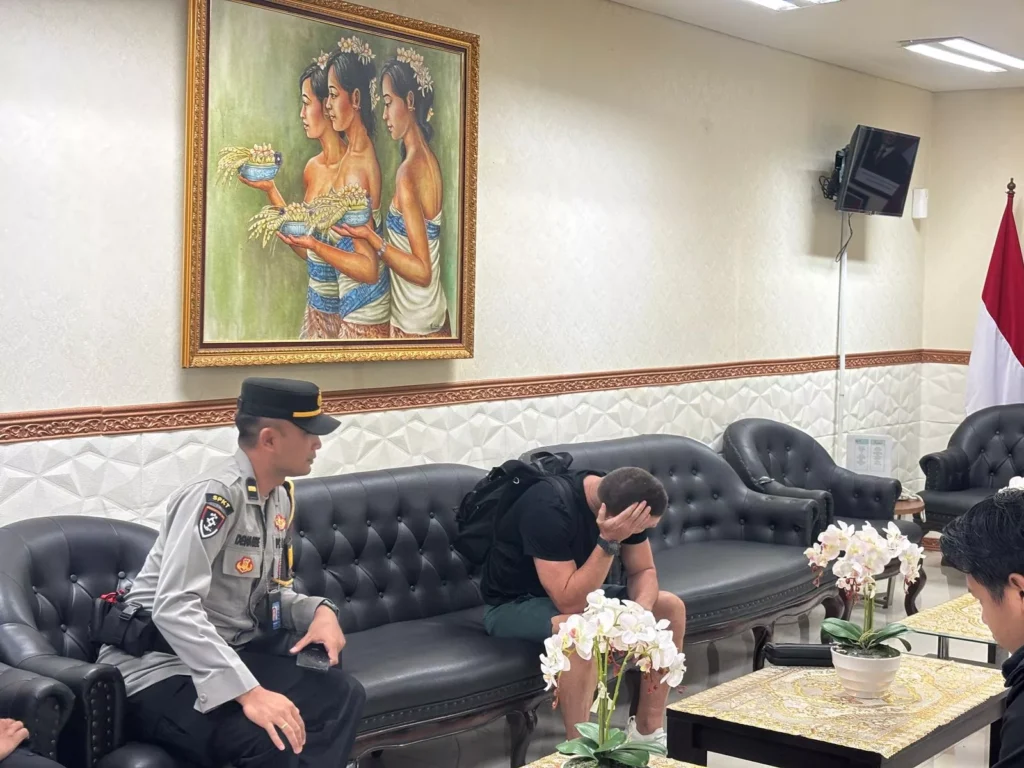
Lyons, who was arrested on March 28 at I Gusti Ngurah Rai International Airport shortly after landing from Singapore, initially told investigators he had traveled alone.
He described the two individuals as acquaintances, suggesting they had come to Bali for tourism.
But authorities are not convinced.
Information shared by law enforcement counterparts in Spain indicates that both men are believed to be part of the same criminal network—one described as highly organized and potentially dangerous.
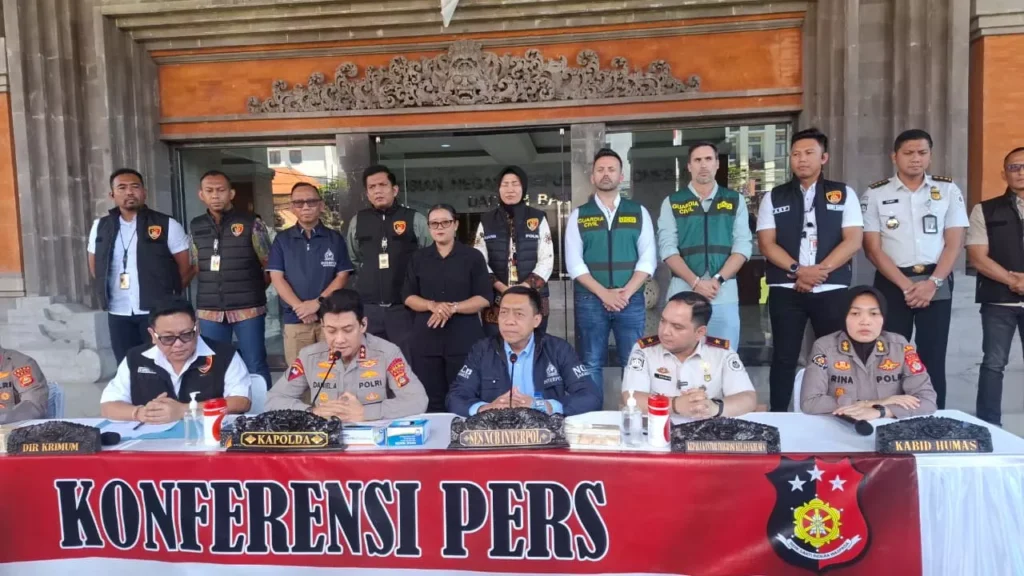
Photo of the Press Conference Regarding the Detention of European International Fugitive, Steve Lyons at the Bali Police Headquarters, March 31, 2026 (Hey Bali)
Not on Red Notice—But Still Under Watch
Neither Larwood nor Wang appears on Interpol’s Red Notice list. Yet Indonesian authorities have made clear that this does not lessen the urgency of the search.
Police say both individuals are still believed to be in Bali and have not been recorded exiting the island. Their movements are now under close monitoring, including checks on travel routes and border crossings.
More importantly, investigators suspect their presence in Bali may not have been incidental.
“There is a belief they had another purpose beyond tourism,” officials said, pointing to early indications that the two may have been exploring potential networks or connections within Indonesia.
A Larger Operation Unfolding
Lyons’ arrest is part of a wider international crackdown.
The 45-year-old is listed on Interpol’s Red Notice and is wanted in connection with a range of serious crimes, including drug trafficking, money laundering, and involvement in violent incidents in Spain.
His capture in Bali followed intelligence coordination between Indonesian authorities and international partners under Operation Armourum, a multinational investigation led by Spain’s Guardia Civil and Police Scotland.
Just one day before Lyons arrived in Indonesia, coordinated raids across Europe led to the arrest of dozens of individuals linked to the same network—33 in Scotland and 12 in Spain.
Why Bali Matters
For Bali, the case underscores a growing reality.
Long known as a destination for tourism, the island is also a global transit point—accessible, connected, and increasingly visible within international travel networks.
That visibility brings opportunity. It also brings risk.
The presence of high-profile fugitives—and potentially their associates—raises questions about how criminal networks move across borders, and how quickly enforcement systems can respond.
Beyond One Arrest
Lyons is expected to be deported to face trial in Europe.
But the investigation in Bali is not over.
Authorities are now focused on determining whether his associates remain on the island—and if so, what they intended to do.
For now, the case serves as a reminder that in a world of open borders and rapid travel, the line between tourism and transnational crime can sometimes be thinner than it appears.
And when it is crossed, the consequences rarely remain local.