


































BADUNG, Bali — For years, Bali has been sold as a place where safety is assumed, where the biggest risk is a sunburn or a missed flight. That assumption is now being publicly challenged—not by social media influencers or tabloid headlines, but by a foreign government that has decided to speak with unusual bluntness.
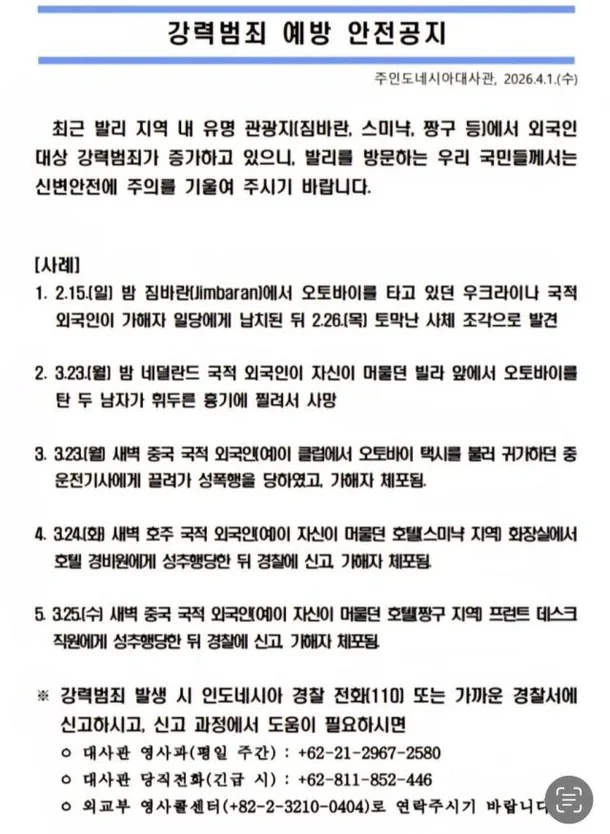
The Embassy of the Republic of Korea in Indonesia issued a security advisory on April 1 that broke sharply with standard diplomatic language. Instead of vague cautions, it itemized specific cases: a kidnapping and murder, a fatal stabbing, and a series of sexual assaults—all involving foreign nationals, all occurring within a six‑week window.
“As violent crimes against foreigners have recently increased in popular tourist destinations such as Jimbaran, Seminyak, and Canggu in Bali, people visiting Bali should pay attention to their personal safety,” the embassy stated.
The notice is not a travel ban. It is not a warning to stay away. But it is something arguably more significant: a formal acknowledgment that Bali’s safety environment has changed enough for a foreign government to say so out loud.
What the Advisory Said
The embassy listed five incidents between February and late March 2026:
- February 15: A Ukrainian national was kidnapped in Jimbaran while riding a motorcycle. His remains were discovered on February 26. Police believe the suspects are part of a transnational criminal network.
- March 23: A Dutch national was fatally stabbed by two men on a motorcycle outside his villa in North Kuta.
- March 23 (same night): A Chinese national reported being sexually assaulted by a motorcycle taxi driver after leaving a club.
- March 24: An Australian woman was sexually assaulted by a hotel security guard in a bathroom in Seminyak.
- March 25: A Chinese national reported being sexually assaulted by a front desk employee in Canggu.
The embassy’s decision to name specific locations—Jimbaran, Seminyak, Canggu—and specific crimes marked a departure from the typically guarded language of consular advisories.
“This is not routine,” said Giostanovlatto, a Bali‑based tourism observer and founder of Hey Bali. “Embassies usually speak in generalities. When they start citing case details, it means the situation has crossed a threshold.”
The Numbers Behind the Warning
The advisory comes as Bali continues to break tourism records. In 2025, the island welcomed more than 7 million international visitors—an 11 percent increase from the previous year. South Korea is among its top five source markets, with more than 51,000 arrivals in the first two months of 2026 alone.
But as visitor numbers have grown, so have certain categories of crime. Bali Police data shows that crimes involving foreign nationals rose by 47 percent in 2025 compared to 2024. Authorities have attributed part of the increase to international criminal syndicates operating in tourism corridors.
In response, police launched “Operasi Sikat Agung 2026” earlier this year, a high‑intensity operation targeting theft and violent offenses in areas frequented by international travelers.
A Shift in Perception
For Giostanovlatto, the embassy’s warning is not merely about the crimes themselves, but about what they represent.
“Bali has not suddenly become unsafe,” he said. “But the perception of safety is a fragile thing. When a country like South Korea—with tens of thousands of citizens visiting Bali each year—issues a notice this detailed, it changes the conversation. Tourists don’t just hear about a crime. They hear that their own government is worried.”
He noted that the timing of the advisory—issued ahead of peak travel seasons—amplifies its impact.
“This will be discussed in travel forums, in family conversations, in corporate travel policies. The embassy’s statement will outlive any single news cycle.”
What the Embassy Advises
The Korean embassy urged travelers to take practical precautions:
- Avoid late‑night travel in unfamiliar areas.
- Use official transportation services rather than hailing rides on the street.
- Report any criminal activity immediately to the Indonesian police or to the embassy’s consular department.
The notice also provided emergency contact numbers, including the embassy’s duty office and the Ministry of Foreign Affairs’ consular call center.
A Broader Question
The advisory does not suggest that Bali is off‑limits. But it does suggest that the island’s tourism infrastructure—its security, its transport regulation, its law enforcement response—is being tested in ways that have become visible enough for a foreign government to act.
“The real issue is not whether Bali is safe,” Giostanovlatto said. “The real issue is whether the systems that keep it safe are keeping pace with growth. And right now, the answer is mixed.”
He pointed to gaps in transport regulation, uneven security standards in the villa economy, and the reactive nature of law enforcement as areas that need urgent attention.
“Tourists will still come,” he said. “But the assumption that nothing bad will happen here is no longer something any government is willing to guarantee.”
A foreign embassy has done what local authorities have been reluctant to do: it has named the problem in plain language. The crimes are serious. The locations are specific. And the warning is public.
For Bali, the message is not that the island is dangerous. It is that the era of unquestioned safety—the assumption that paradise is also a fortress—is over.
As Giostanovlatto put it: “Bali is still beautiful. Bali is still welcoming. But Bali is no longer invisible to the risks that exist everywhere. And now, everyone knows it.”
Hey Bali News will continue to monitor safety developments and their impact on the island’s tourism economy.