
































A widow in East Nusa Tenggara says she was blindsided to learn that land her family has farmed for nearly two centuries now appears on an official certificate under the name of a sitting regional lawmaker, a case that highlights a persistent risk facing anyone navigating Indonesia’s land ownership system, in Bali included.
Anastasia Lotu, a resident of Belu Regency, said she discovered that Januaria Awalde Berek, Deputy Speaker of the Belu Regional House of Representatives (DPRD), claims to hold a certificate of ownership over roughly 750 square meters of land in Wehas Hamlet, Mandeu Village, Raimanuk District, despite the dispute previously being resolved at the village level.
“I was shocked to learn that Mrs. Januaria Awalde Berek claims to have a land ownership certificate for this land,” Anastasia told hey bali on Thursday, July 23, 2026.
A Multi-Generational Claim
According to Anastasia, the land is customary territory belonging to the Uma Bei Sesu and Uma Bei Hoar clans. She said her family has cultivated it since 1826, and that it was passed down to her in 1973.
“This land has been cultivated by my ancestors since 1826. After I got married, my parents passed this land down to me in 1973 to cultivate to this day. Where did Mrs. Walde suddenly get a certificate for it?” Anastasia said.
A Dispute That Was Supposedly Already Settled
Anastasia said the dispute first emerged in 2015, when Januaria allegedly asked a resident named Nai Bouk Siku to file an ownership claim over the land with the Rafae Village Government.
The matter was reportedly resolved through a village-level dispute resolution process in 2016, involving village officials and law enforcement. During that process, Anastasia said the Gerindra Party politician was unable to produce evidence of ownership.
Anastasia, by contrast, said she presented multiple forms of evidence supporting her family’s claim: long-established crops on the land, a well her family built in 1973 with the help of a German missionary, and a Catholic elementary school, SD Katolik Amahatan, built on land her family had donated to the Astanara Foundation.
She said customary elders also confirmed the land as ancestral territory long controlled by her family. Following the resolution process, Anastasia said both village officials and police authorized her to resume cultivating the land.
“At that time, the village head and police told me to go back to farming, and I’ve continued to do so since, because I won,” Anastasia said.
The Dispute Resurfaces
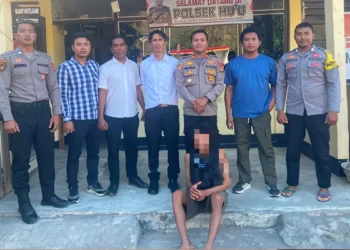
The issue resurfaced on July 1, 2026, when Anastasia and her family were cutting down trees on the land to renovate an old family home. Officers from Raimanuk Police Sector stopped the activity and confiscated the cut timber.
According to Anastasia, police explained the seizure followed a report from Januaria, who claimed the land was now certified under her name.
“I was shocked because suddenly the wood my mother had planted herself couldn’t be taken. The police said there was a report that the land had a certificate. Maybe because Mrs. Walde is an important person, she can just take land however she pleases,” Anastasia said.
Several days later, Anastasia and family members were summoned to Raimanuk Police Sector for questioning. She said she asked investigators to show her the certificate underlying the report, but her request was not granted.
“I asked to see the certificate under Mrs. Walde’s name, but the police wouldn’t show it, they only showed a land plot diagram,” Anastasia said.
A Longstanding Tax Record
Anastasia said she has consistently paid property tax (PBB) on the land. The tax was originally recorded under her late husband Benyamin Yos Bou’s name; after his death in 2009, the payments were transferred to her name.
“I’ve paid the tax on this land up to now. It used to be under my husband’s name, and since he passed away in 2009, the payments have been under my name,” she explained.
A Call for Help
Anastasia said she hopes someone with legal expertise can help her resolve the matter fairly.
“I’m just an elderly widow. I hope there are people who understand the law who can help me resolve this fairly. I just want to farm on my ancestral land without constantly feeling afraid and pressured. This land has been our family’s source of livelihood since long ago,” she said.
Januaria Awalde Berek had not responded to hey bali request for confirmation and clarification at the time of publication.
Why This Case Resonates Beyond Belu
For anyone who has purchased, leased, or built on land in Bali, or is considering doing so, this case lands close to home, even from several hundred kilometers away. Disputes involving overlapping land certificates, customary land claims, and questions over who actually holds legitimate title are not unique to Belu. Similar patterns, competing certificates, unclear customary boundaries, and power imbalances between claimants, have surfaced repeatedly in Bali’s own property market, where foreign buyers and long-term renters have occasionally found themselves entangled in ownership disputes only after signing a lease or investing in a build.
The case serves as a pointed reminder that a land certificate, on its own, doesn’t always settle a dispute definitively, and that verifying land history, customary claims, and documentation through independent legal counsel remains essential anywhere in Indonesia, not just in courtrooms far from the tourist trail.