


































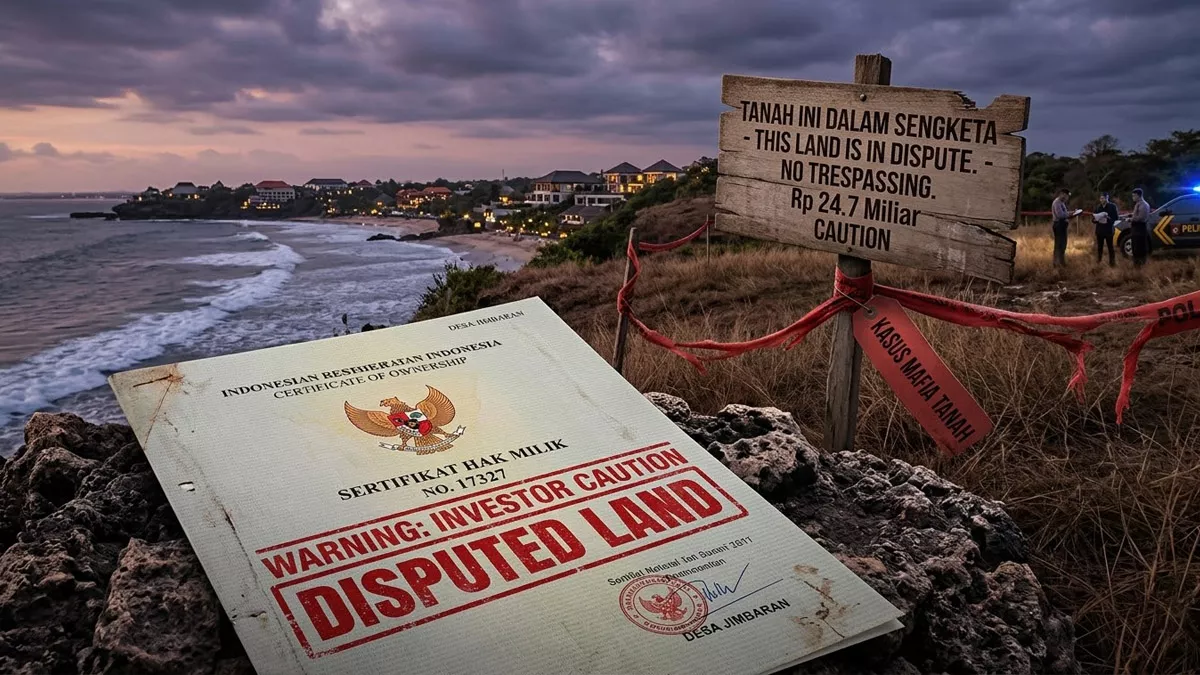
BADUNG, Bali — For investors and expatriates dreaming of owning a piece of Bali’s most coveted real estate, the promise of a “clear and clean” land title is the ultimate assurance. But for one Jakarta woman, that promise turned into a nightmare—and a $1.5 million lesson in the risks lurking beneath the island’s booming property market.
The victim, identified only as SN, purchased land in Jimbaran, one of Bali’s most sought-after areas, only to discover that the property was entangled in overlapping claims, pending lawsuits, and a history of disputes that should have made it unsellable.
By the time she realized what had happened, Rp 24.7 billion (approximately $1.5 million) had already changed hands. And the sellers, according to her legal team, never had full authority to sell.
The Anatomy of a Scam
The transaction began with an enticing offer. SN and her business partner, identified as Desak, were approached with an opportunity to purchase land in Jimbaran described as “clear and clean”—a term used in Indonesian property transactions to indicate that a title is free of disputes, liens, or legal complications.
Trusting the offer, SN made a series of payments: Rp 500 million as a down payment, followed by Rp 20 billion, and later an additional Rp 4.27 billion. The total: Rp 24.7 billion.
The Sale and Purchase Agreement included a critical clause: if the property turned out to be problematic, the money would be refunded. But when SN discovered in October 2024 that the land was actually embroiled in multiple ownership claims and legal disputes, the sellers refused to return her funds.
Overlapping Claims and Hidden Histories
The land in question, a 22,790-square-meter parcel with a SHM certificate (Certificate of Ownership) Number 17327 in Jimbaran, appeared to have multiple owners. According to legal documents, the land was registered under five individuals: I Made Sukanata, I Nyoman Sudirga, I Ketut Soka, I Nyoman Sulendra, and I Made Sudana.
The sale was facilitated by a representative named Bun Djokosudarmo, who claimed to hold power of attorney under a legal document dated July 2, 2024.
But the ownership picture was far more complicated. SN’s legal team later discovered that the same land was also claimed by at least two other parties—Komang Dewata and Wayan Wirasnada—as well as an entity called Jimbaran Property (JP).
Court records revealed that the land had been the subject of previous legal proceedings, with rulings that did not favor those claiming ownership. In other words, the property was under active dispute—and had been for some time.
Yet none of this was disclosed to the buyer.
The Role of the Notary
Perhaps most troubling for investors is the role of the Pejabat Pembuat Akta Tanah (PPAT), the official authorized to draft land deeds. Under Indonesian law, PPATs are legally obligated to verify the administrative and legal status of any property before facilitating a transaction.
In this case, SN claims she was never informed about the land’s disputed status—even though the transaction was processed through official channels.
“The land was not only problematic, but it was also allegedly sold by parties without full authority. There are multiple claims on a single parcel. This needs to be exposed clearly,” said I Made “Ariel” Suardana, the victim’s legal counsel.
He also raised concerns about potential negligence—or worse, complicity—among those who allowed the transaction to proceed.
“If it was already known that there was a dispute and even a legal history, the transaction should never have been allowed to continue. There are strong indications that certain parties played a role in facilitating this,” he said.
A Pattern of Land Mafia Practices
The case has drawn renewed attention to the phenomenon known in Indonesia as mafia tanah—”land mafia”—a term used to describe networks that exploit legal loopholes, forged documents, and administrative gaps to profit from disputed land.
In Bali, where land values have skyrocketed due to tourism and foreign investment, these practices have become a growing concern. The island’s appeal to international investors, expatriates, and second-home buyers has made it a prime target for fraud.
Victims are often drawn in by seemingly legitimate offers, only to discover years later that the land they purchased was never legally theirs—or that multiple parties hold competing claims.
Legal Proceedings and Investor Lessons
SN filed a police report with Polda Bali in March 2025, alleging fraud, embezzlement, and the inclusion of false information in official documents. The charges fall under Articles 378, 372, and 266 of the Indonesian Criminal Code.
Several witnesses have been questioned, but as of now, no suspects have been formally named—a development that has frustrated the victim and her legal team.
For foreign investors and expatriates considering property purchases in Bali, the case offers a sobering checklist:
- Hire independent legal counsel. Do not rely solely on the seller’s notary or representatives. An independent lawyer can conduct a thorough title search and verify ownership history.
- Check court records. Disputes often appear in local court filings before they become public scandals. A diligent legal team will search for any ongoing or past litigation involving the property.
- Verify power of attorney. If the seller is acting on behalf of others, ensure that the power of attorney document is authentic, properly executed, and grants clear authority to sell.
- Demand transparency. If a property is marketed as “clear and clean,” ask for documentation that proves it—including tax receipts, certificate history, and confirmation from the local land office (Badan Pertanahan Nasional).
- Use escrow arrangements. Where possible, structure payments through an escrow account tied to the successful transfer of clear title.
A Warning for Bali’s Property Market
The Jimbaran case is not an isolated incident. As Bali’s real estate market continues to attract international capital, the risks of land fraud are likely to persist—and evolve.
For now, SN’s Rp 24.7 billion remains in limbo, the land she thought she owned still tangled in competing claims, and her legal battle continues. Her story is a cautionary tale for anyone tempted by the dream of owning a piece of paradise.
As her lawyer put it, “This case needs to be uncovered thoroughly. If not, it will only embolden those who see Bali’s land market as a place to exploit, not invest.”
The investigation is ongoing.















Comments 2