
































Bali Rules for Tourists Updated July 2026 | Based on Bali’s latest official regulations and enforcement policies.
Land in Bali without reading a single word about local regulations, and you can still have a wonderful trip, until the moment you don’t: a temple visit cut short over inappropriate dress, a scooter stopped without an international license, or a night out that ends with a formal warning for public misconduct. Bali isn’t lawless, and since 2023, it has been considerably less ambiguous about what it expects from the millions of foreign visitors who arrive each year.
A Rulebook Born From Growing Frustration
Bali’s current tourist code of conduct traces back to Circular Letter (SE) Number 4 of 2023, issued by then-Governor I Wayan Koster, and later updated and strengthened under Circular Letter (SE) Number 7 of 2025. The update wasn’t cosmetic. According to Koster, the province revisited the rules specifically because “as things change, we need to adapt,” a response to a documented rise in traffic violations, temple desecration, and public misconduct by foreign visitors in the years following Bali’s post-pandemic tourism rebound.
The rules aren’t merely suggestions. Bali has assembled a dedicated enforcement task force working alongside the island’s Civil Service Police Unit (Satpol PP), and authorities have set up a public WhatsApp hotline (+62 812-8759-0999) specifically for residents and businesses to report violations directly to police for investigation.
Why Bali Introduced These Rules
The numbers behind this crackdown are hard to ignore. Bali welcomed 6.3 million foreign tourist arrivals in 2024, nearly half of Indonesia’s total 13.9 million international visitors that year, and arrivals have only climbed since. Alongside that growth, Indonesia’s Directorate General of Immigration recorded 378 foreigners deported from Bali between January and September 2024 alone, up from 335 for all of 2023.
The trend accelerated further in 2025: nationally, immigration recorded 2,669 deportations and 2,009 detentions between January and July 2025, with Bali accounting for a significant share. According to reporting on the crackdown, 2025 set a record with roughly 1,430 total deportations from Bali specifically, driven partly by a public complaint hotline that can move a report from WhatsApp message to passport seizure within 24 to 48 hours in serious cases.
Immigration Director General Silmy Karim has been blunt about the range of violations behind these numbers: visa overstays, illegal work, abuse of investor visas, and in some cases, involvement in transnational crime. “Some foreigners were even involved in transnational crimes, while others resisted law enforcement or disrespected Balinese traditions,” he said.
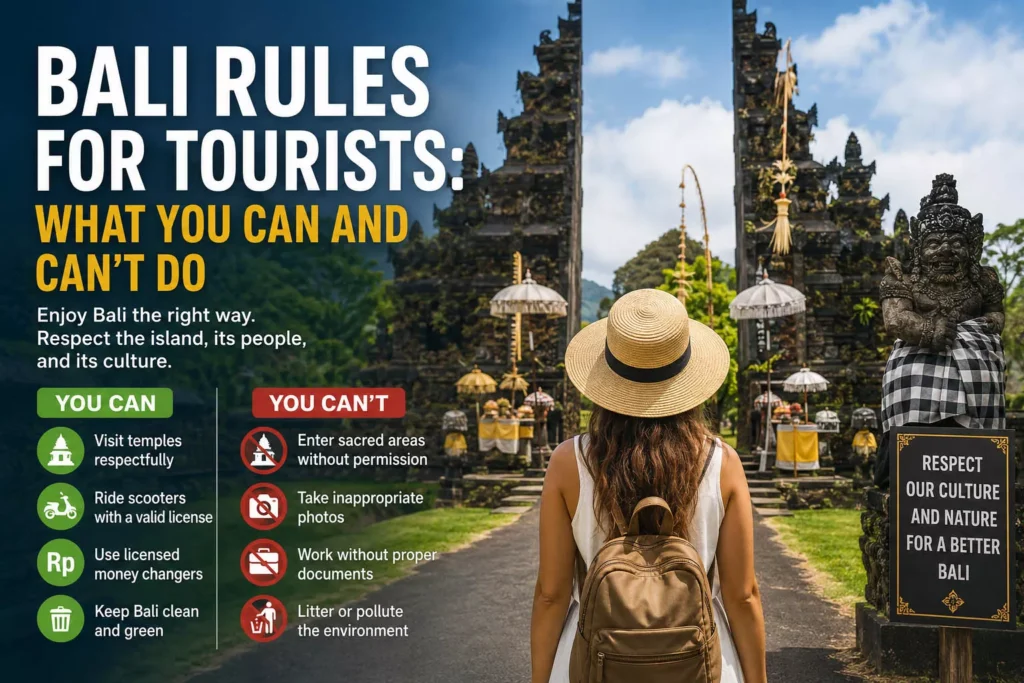
What Tourists in Bali Should Do
| Category | Requirement |
| Sacred sites | Show respect for temples, pratima (sacred statues), and religious symbols at all times |
| Local customs | Respect Balinese customs, traditions, arts, and culture, particularly during ceremonies and processions |
| Dress code | Dress modestly and appropriately at temples, tourist attractions, and public places |
| Public conduct | Behave politely in temples, tourist areas, restaurants, shops, and on public roads |
| Guided visits | Use a licensed tour guide when visiting tourist attractions |
| Currency exchange | Exchange money only at licensed money changers authorized by Bank Indonesia |
| Payments | Use Indonesian Rupiah and the national QRIS payment system for transactions |
| Tourist levy | Pay the foreign tourist levy (IDR 150,000, approx. $9.24) online via lovebali.baliprov.go.id before or upon arrival |
| Transportation | Use only legal, registered transportation services |
| Accommodation | Stay only at properly licensed and permitted accommodations |
| Driving | Hold a valid international or national driving license, wear a helmet, and follow all traffic laws |
| Site-specific rules | Follow any special provisions posted at individual tourist attractions |
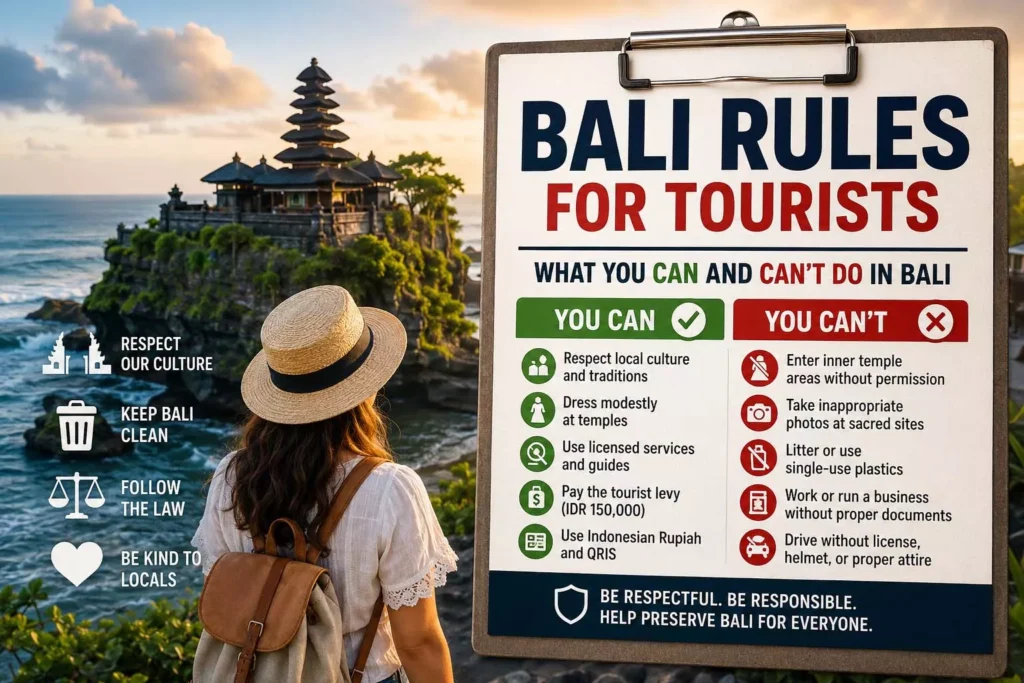
What Tourists in Bali Are Prohibited From Doing
| Category | Prohibition |
| Sacred temple areas | Entering the utamaning mandala or madyaning mandala (inner temple sanctums) unless praying in traditional Balinese attire; menstruating individuals are also barred from these areas |
| Sacred structures | Climbing sacred trees, monuments, or buildings, including for photos |
| Religious desecration | Taking inappropriate or nude photos at religious or sacred sites |
| Environment | Littering or polluting lakes, rivers, springs, the ocean, or public spaces |
| Plastic use | Using single-use plastics, including plastic bags, styrofoam, plastic straws, and plastic-packaged drinks |
| Public conduct | Swearing, causing disturbances, or behaving aggressively toward locals, officials, or fellow tourists |
| Online conduct | Spreading hate speech or misinformation about Bali or its residents on social media |
| Work and business | Working or operating a business in Bali without proper Indonesian documentation |
| Illegal trade | Trading drugs, endangered wildlife, sacred artifacts, or other prohibited goods |
| Reckless driving | Driving without a helmet, shirt, valid license, or in a reckless manner |
Mistakes Tourists Make Most Often

Despite clear rules, the same handful of violations account for the majority of complaints and enforcement actions:
- Riding a scooter without an International Driving Permit (IDP), still one of the most common traffic violations recorded by Bali police.
- Entering temples improperly dressed, arriving without a sarong or covering, particularly at high-traffic sites like Uluwatu and Tanah Lot.
- Standing on sacred shrines for photos, a violation that has led to viral controversy and, in several documented cases, formal deportation.
- Overstaying visas, consistently cited by immigration officials as one of the leading causes of deportation from Bali.
- Using illegal or unlicensed money changers, which remain common in tourist areas despite repeated warnings and carry real fraud risk on top of the regulatory violation.
Why Bali Cracked Down on Motorbikes Specifically

Among the most consequential rule changes involves motorbikes, historically the default way tourists get around the island. Following a documented spike in traffic violations, police reported that more than 170 foreign nationals broke traffic laws in just a two-week span between late February and March 2023 alone, offenses ranging from drunk driving and speeding to using fake license plates.
“As tourists, act as tourists,” Koster said at the time, encouraging visitors to use vehicles arranged through licensed travel agents rather than “roaming around with motorbikes, without wearing t-shirts and clothes, with no helmets, violating traffic rules, and even without a license.” While an outright rental ban has not been fully implemented island-wide, the direction of policy is unambiguous: tourists riding motorbikes in Bali without a valid international or national driving license, a helmet, and full compliance with traffic law are now squarely in violation of the current code of conduct, not simply taking a minor risk.
What Happens If You Break the Rules

Violations of Circular Letter Number 7 of 2025 carry real consequences, not just a stern conversation with a Satpol PP officer. Tourists who fail to pay the mandatory tourist levy can be denied entry to major attractions including Uluwatu Temple and the Tegallalang Rice Terraces. More serious violations, including illegal work, wildlife trafficking, or repeated disorderly conduct, can result in fines, formal legal proceedings under Indonesian law, and in the most serious cases, deportation, an outcome that, as the numbers above show, is now happening at a record pace.
Koster has been direct about the province’s intent: “Bali is a beautiful, sacred island, and we expect our guests to show the same respect that we extend to them.”
Frequently Asked Questions
Do I have to pay a tourist tax to visit Bali?
Yes. Foreign tourists are required to pay a one-time levy of IDR 150,000 (approximately $9.24) through the official Love Bali portal (lovebali.baliprov.go.id) before or upon arrival. Failure to pay can result in being denied entry to major attractions like Uluwatu Temple.
Can tourists rent and ride motorbikes in Bali?
Riding a motorbike is not outright banned, but it requires a valid international or national driving license, a helmet, and full compliance with Indonesian traffic law. Riding without a license, helmet, or shirt violates the current tourist code of conduct and can result in fines or legal consequences.
What should I wear when visiting a temple in Bali?
Modest, appropriate clothing is required at all sacred sites, typically covering shoulders and knees, often with a sarong provided or rented at the entrance. Entering the temple’s inner sanctum (utamaning mandala or madyaning mandala) is restricted to worshippers in traditional Balinese attire, and menstruating individuals are prohibited from entering these areas.
What happens if I don’t follow Bali’s tourist rules?
Consequences range from being denied access to attractions and receiving formal warnings to fines, legal proceedings under Indonesian law, and, in serious or repeated cases, deportation. Reports can be filed by locals or fellow tourists through an official WhatsApp hotline directly to Bali’s police, and complaints can escalate to passport seizure within 24 to 48 hours in serious cases.
Are single-use plastics really banned for tourists in Bali?
Yes. Plastic bags, styrofoam, plastic straws, and plastic-packaged drinks are prohibited under the current tourist regulations, part of a broader environmental push tied to Bali’s ongoing pollution and waste management challenges.

Bali’s rules aren’t designed to make visitors feel unwelcome. They’re designed to protect an island where tourism and daily life exist side by side.
Most travelers will never notice these rules because they’re already traveling respectfully.
But spending ten minutes understanding them before you arrive can save hours of frustration, fines, or even legal trouble after you land.