
































For anyone who’s witnessed a traffic accident on Bali’s often-chaotic roads, wondering how quickly help will actually arrive, Denpasar’s Red Cross now has an answer: 15 minutes, and they’re working to make it faster.
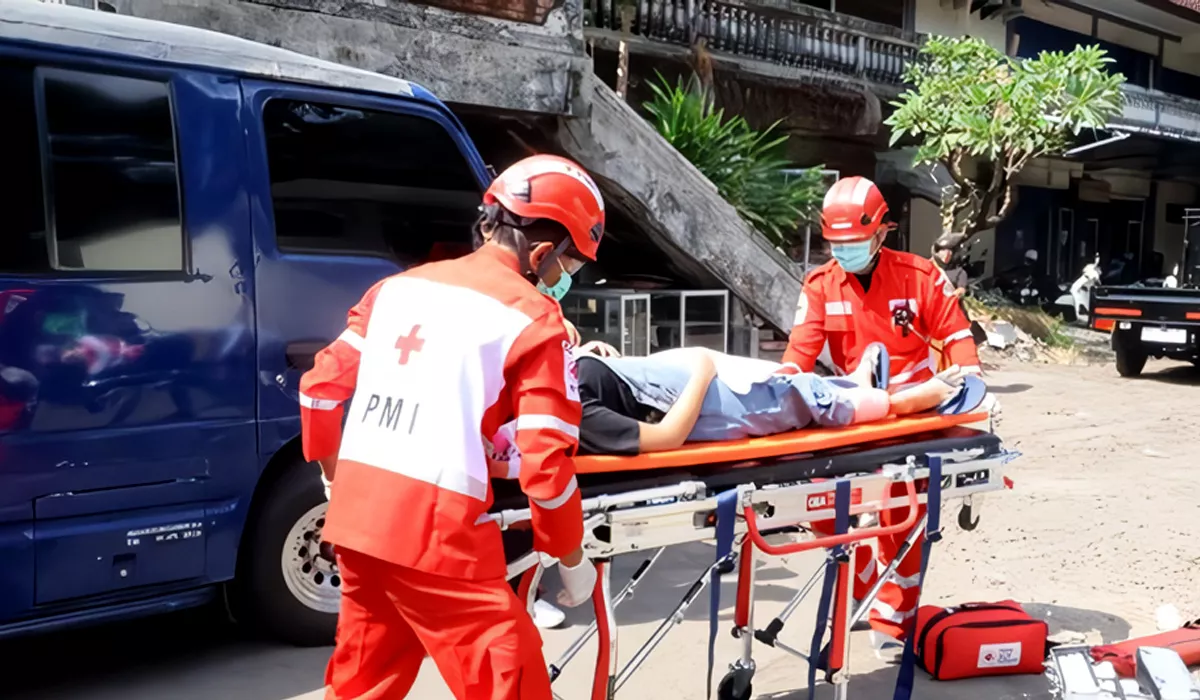
The Indonesian Red Cross (PMI) in Denpasar held an ambulance crew training simulation at its headquarters on Jalan Imam Bonjol on Monday, July 20, 2026, aimed at sharpening how quickly and effectively responders can reach and evacuate accident victims.
A Clear Response Time Target
“In today’s simulation, the maximum time needed for a team to travel from our office to the incident location was 15 minutes. In the field, our target is actually to be faster than that, so victims can receive first aid before being referred to a hospital,” explained I Made Yoga Adi Kusuma, Head of Communications for Denpasar’s Red Cross.
To support that goal, Denpasar PMI has expanded its operational capacity with two new ambulances now running full-time, 24 hours a day. The fleet is staffed by 12 on-call personnel divided into four teams.
What the Training Actually Covered
The training ran from July 13 to July 20, combining theoretical instruction with hands-on individual practice. Scenarios included treating injured patients, handling fractures, and simulating the evacuation of traffic accident victims trapped inside vehicles.
“We have competent trainers under the Bali Provincial Red Cross ensuring medical response standards remain at the highest level,” Yoga said.
Coverage Gaps and How They’re Bridged
Yoga acknowledged that Denpasar’s Red Cross unit is only able to directly cover the West Denpasar area. “For the rest, we collaborate with Denpasar’s Regional Disaster Management Agency (BPBD) and the nearest emergency health posts so victims still receive prompt service without long delays. But if a call falls within a reachable range outside our primary zone, PMI is ready to respond,” Yoga said.
He confirmed that Denpasar PMI’s basic equipment remains adequate and ready for use. However, one significant gap remains: the unit currently lacks an automated external defibrillator (AED), a critical piece of equipment for responding to cardiac arrest.
“For cases of respiratory or cardiac arrest, whether en route or at a patient’s home, we currently don’t have an AED. Denpasar PMI’s management is working hard and continuing to coordinate with the Denpasar City Government to secure this advanced equipment as soon as possible,” he added.
Why This Matters Beyond Emergency Response Times
For Bali’s international community, this update carries practical weight. Denpasar’s roads, and Bali’s more broadly, see a steady stream of traffic incidents involving both residents and tourists, and knowing the realistic response window for emergency medical services is genuinely useful information, particularly for expats and long-term visitors navigating the island by scooter, a mode of transport tied to some of the region’s more serious traffic-related injuries.
The AED gap is also worth flagging for anyone with pre-existing cardiac risk factors: while trained responders can arrive within roughly 15 minutes, the absence of an on-site defibrillator means outcomes for sudden cardiac arrest may still depend heavily on bystander CPR and how quickly a patient can be transported to a hospital equipped with one.
Building Community-Level Preparedness
Yoga emphasized that Denpasar PMI’s core strength doesn’t rest solely on ambulances and its main response teams. “We’re also expanding our network of volunteers down to the village level, to build public awareness and preparedness,” he said, a strategy aimed at closing response gaps in areas outside the unit’s direct coverage zone before a call for help is even made.
#heybalinews | Source: Detik